
- English
- Español
- Português
- русский
- Français
- 日本語
- Deutsch
- tiếng Việt
- Italiano
- Nederlands
- ภาษาไทย
- Polski
- 한국어
- Svenska
- magyar
- Malay
- বাংলা ভাষার
- Dansk
- Suomi
- हिन्दी
- Pilipino
- Türkçe
- Gaeilge
- العربية
- Indonesia
- Norsk
- تمل
- český
- ελληνικά
- український
- Javanese
- فارسی
- தமிழ்
- తెలుగు
- नेपाली
- Burmese
- български
- ລາວ
- Latine
- Қазақша
- Euskal
- Azərbaycan
- Slovenský jazyk
- Македонски
- Lietuvos
- Eesti Keel
- Română
- Slovenski
- मराठी
- Srpski језик
Brushless vs. Brushed Drills: Differences, Performance, and Cost
2026-11-04
A brushed drill uses carbon brushes and a commutator for motor commutation; a brushless drill uses electronic commutation. Removing the brush contact removes a wear item and offers opportunities for efficient motor control. Whether a particular drill earns its price premium depends on the complete configuration, the work it completes, and how it will be serviced.
For importers and distributors, the useful question is which product fits the customer and can be supplied consistently. A brushless label cannot answer that alone. Battery specifications, gearing, chuck, operating modes, handling, and service arrangements all belong in the comparison.
Searches for “brushless vs non-brushless drills” or “brushless vs regular drills” usually lead to this same choice. Use the specific terms brushed and brushless when writing a quotation or accessory list; “regular” leaves the motor construction unclear.
Brushless vs. brushed drills: key differences at a glance
Use motor type to understand the design, then use model-specific evidence to judge the drill. The following table separates the engineering difference from the purchasing check.
| Factor | Brushed drill | Brushless drill | Buyer check |
|---|---|---|---|
| Commutation | Brushes contact a rotating commutator. | Electronics switch current through the motor windings. | Confirm the exact model's motor construction. |
| Energy losses | Brush contact adds friction, electrical losses, and wear. | No brush-contact losses; other motor and drive losses remain. | Compare accepted work per charge under defined conditions. |
| Power and control | Depends on motor, battery, gearing, and control design. | Electronic control offers different ways to manage the motor. | Check loaded behavior, control, and rated applications. |
| Maintenance | Brushes and commutator condition can require attention. | No carbon brushes to replace. | Review the whole tool's maintenance instructions. |
| Repair | Brush replacement may be possible, depending on construction. | Motor or electronic-drive repair may involve modules. | Ask which parts can be supplied and serviced. |
| Size and handling | Varies with the required output and tool layout. | Motor design can support a compact package. | Handle the complete tool with its intended battery. |
| Purchase value | A lower-cost option can suit a well-defined basic task. | A premium can be justified by useful performance or service benefits. | Compare equivalent kits and expected ownership costs. |
There is a sound engineering basis for brushless motor benefits. Turning those benefits into a fixed runtime percentage, guaranteed lifespan, or professional-use rating requires evidence for the actual tool.
What does brushless mean on a drill?
A brushless drill contains a motor that does not use carbon brushes for commutation. In a typical cordless BLDC arrangement, stationary windings create a changing magnetic field that turns a permanent-magnet rotor. The drive electronics control the switching sequence.
What is a brushed drill?
In a common brushed cordless-drill motor, brushes conduct current to the rotating armature through commutator segments. Rotation changes which segments contact the brushes, switching current through the windings. The contact is part of normal operation, but the brushes are wearing components.
Where the current is switched
BRUSHED
Battery supplyBrushes + commutatorRotating windings
BRUSHLESS
Battery supplyElectronic driveStationary windings
How electronic commutation differs
Microchip's BLDC motor fundamentals describes the brushless construction and electronic commutation principle. Its motor-control reference also distinguishes sensored and sensorless approaches. Do not assume that every brushless drill uses the same sensors or control algorithm.
Electronic control is not exclusive to brushless tools. A brushed drill can have variable-speed electronics and feedback. “Brushed” does not mean the current is fixed regardless of load; “brushless” does not identify every control or protection feature fitted to a product.
Brushless vs. cordless: two different descriptions
Brushless describes the motor; cordless describes the power supply arrangement. A cordless drill can use either a brushed or a brushless motor. Compare the motor separately from battery compatibility and kit contents.
Motor type also differs from drilling action. A brushless drill does not automatically have a hammer mechanism. Establish the required mode before evaluating the motor upgrade; our hammer drill and rotary hammer comparison covers that separate decision.
Are brushless drills better for power, runtime, and heat?
Brushless designs can make useful gains in efficiency, control, and power density. That gives buyers a reason to evaluate them for repeated work. It does not make every brushless drill stronger than every brushed drill, or turn an entry-level machine into a suitable heavy-duty one.
Loaded performance matters more than an isolated number
No-load speed describes rotation without the working cut. Maximum torque describes another operating condition. Neither tells you how quickly a bit will produce an acceptable hole in a specified material. The gearbox also means motor speed and chuck speed are different quantities.
Mechanical power at one operating point depends on torque and speed together: P (W) = T (N·m) × n (r/min) × 2π / 60. The torque and speed must describe that same point. Multiplying the highest torque on a specification sheet by the highest no-load speed does not establish the drill's output power.
For installation or assembly, also assess low-speed control, stopping behavior, grip, and access. A faster trial is of little use if it damages the screw recess or leaves the hole outside the required condition.
Runtime belongs to the complete system
Useful runtime is the work completed before charging or a necessary interruption. Battery capacity in Ah alone does not establish equal stored energy across voltage classes, and equal energy alone does not establish equal load capability. Pack construction, condition, and permitted operating limits remain relevant.
Compare the path from battery to finished work
SUPPLY
Approved battery, charge state, condition, and operating limits.
DRIVE
Controller, motor, gearing, and the selected speed range.
TASK
Accessory, workpiece, hole or fastener requirement, and work/rest cycle.
A larger battery, a sharper bit, or a different gear can change the outcome of a comparison. These may be valuable configuration differences, but they should remain visible in the record instead of being attributed entirely to motor type.
Heat and control still need engineering
Eliminating brush contact removes one source of loss. Current still produces heating in the windings, while the electronic drive has conduction and switching losses. Cooling and control therefore remain part of the design. TI's BLDC motor-driver selection guide discusses voltage, current, architecture, and thermal considerations as system decisions.
Winding resistive loss follows P = I²R. For illustration, increasing winding current from 20 A to 30 A at a fixed resistance increases that loss by (30/20)² = 2.25 times. These currents are calculation inputs, not measured BOSI operating values. The ratio describes resistive heating power; it does not predict temperature rise, total tool losses, runtime, or service life. Winding resistance also changes with temperature, so the fixed-resistance condition matters.
This is why I would evaluate repeated-work performance alongside interruptions and load control. A drill that completes one demanding hole can still be a poor match for a repeated work cycle. Select within the manufacturer's rated application and compare acceptable output over the intended cycle, rather than treating the brushless label as permission to sustain any load.
When reviewing a longer-runtime claim, ask which drill and battery were compared, what task was repeated, and what counted as completion. Keep time spent cutting, battery changes, required pauses, and rejected work separate. A result from one task is evidence for that setup, not a universal percentage for every accessory and material.
Do brushless drills last longer? Maintenance and repair compared
Removing a wearing contact gives brushless motors a durability advantage to evaluate. Whole-tool life still depends on the remaining components and operating conditions. A tool can leave service because of a battery, switch, chuck, gearbox, or electronic fault before the motor itself reaches its limit.
Brush wear is one failure mechanism
In a brushed design, brush and commutator condition can eventually require service. Whether brushes can be replaced economically depends on the actual motor construction, access, spare parts, and repair labor. Do not assume every low-cost brushed drill has externally accessible, replaceable brushes.
A brushless design removes that specific maintenance item. Bearings, mechanical interfaces, cooling passages, and electrical connections still need appropriate inspection and care. “No carbon brushes to replace” is a precise product statement; the tool's maintenance instructions define the rest.
Keep motor, battery, and tool life separate
Operating hours, charge cycles, warranty duration, and calendar age measure different things. A motor-life figure from another application cannot establish how many years a drill will last in service. A useful endurance record identifies the load, cycle, sample configuration, maintenance, and failure criterion.
There is no defensible universal two-times or three-times lifespan multiplier from the motor label alone. Compare documented evidence for the intended workload, then examine which component or condition ended the test.
Plan the repair route before stocking the product
For distributors, ask whether a motor, drive module, switch, chuck, or battery is a service part and how the correct version is identified. Repair complexity and failure frequency are separate questions. A simple repair can still be expensive if freight and handling dominate its cost.
Keep the product identity with the service record. A symptom such as stopping under load should be investigated across the tool, battery, accessory, and application before assigning a cause. That distinction makes a return record more useful than a general “motor failure” label.
Is a brushless drill worth the extra cost?
A brushless premium is worth considering when it buys performance, control, or service benefits that matter to the customer. For infrequent, well-defined work, an appropriately specified brushed drill may already meet the requirement. The answer should follow the job and quotation.
Compare equivalent kits first
Put battery count, pack specification, charger, chuck, operating modes, accessories, case, and agreed service scope beside the price. A bare drill and a two-battery kit are different purchases. A lower unit price can also shift costs into the accessories or support required later.
For the broader kit decision, use our cordless drill and kit buying guide. Keep this motor comparison focused on the differences that remain once the configurations are understood.
User costs and distributor costs have different boundaries
A working crew may value fewer interruptions, lighter handling, or a repeatable fastening result. An importer must also evaluate repair handling, replacement logistics, spare stock, and the service commitment made to dealers. Count a cost only once and use the same evaluation period for both configurations.
An illustrative break-even calculation
Assume a 24-month evaluation period, an order of 100 drills, an additional US$12 per brushless drill, and a US$40 repair-and-handling cost for each service event avoided. These are hypothetical costing inputs for the example. The additional purchase cost is 100 × US$12 = US$1,200. At US$40 per event, 30 avoided service events would offset that premium before other cost differences.
Illustrative purchase-premium threshold
ADDITIONAL COST
100 drills × US$12
US$1,200
ASSUMED SERVICE COST
Repair and handling
US$40 per event
BREAK-EVEN
US$1,200 ÷ US$40
30 avoided events
This calculation sets a question for the evidence: can the selected configuration reasonably avoid those costs? Service records or comparable testing are needed to estimate that. If a brushless product produces a different repair cost, include that difference too. A purchase premium and a motor label are insufficient to calculate an actual return on investment.
Brushed or brushless drills: which fits your product range?
Build the range around customer tasks and price positions. Motor type is one selection field within that plan. Avoid classifying all homeowners as brushed buyers or every professional as a brushless buyer without examining their work.
| Customer requirement | What to prioritize | Evidence to request |
|---|---|---|
| Occasional assembly and repair | Suitable capacity, easy control, complete useful kit, and acceptable purchase cost. | Representative task result, kit list, handling, and support route. |
| Frequent installation and maintenance | Repeated work, control, balance, battery availability, and serviceability. | Comparable sample record with pauses and accepted results included. |
| Demanding repeated drilling | Approved application, stable working combination, and appropriate equipment. | Rated limits and a task-specific evaluation; motor type alone is insufficient. |
| Expansion of an existing battery range | Exact approved tool, pack, and charger compatibility. | Model-specific compatibility confirmation and replacement arrangements. |
Give each product a clear reason to be stocked
A basic kit can serve a defined occasional-use customer without claiming to suit every trade. A brushless configuration can occupy a higher position when its complete specification and verified use justify that position. Distinguish neighboring products through function, capacity, handling, or kit contents, rather than voltage labels alone.
For customers already using cordless tools, battery availability can influence the decision. Confirm exact approved combinations. A shared brand or voltage marking does not establish interchangeable packs. Our cordless power-tool buying guide explains the wider battery and specification checks.
Motor type does not select the drilling mechanism
If the customer needs masonry drilling, determine the appropriate mechanism, bit, and material rating first. If the work is mainly screws and ordinary holes, assess that configuration on its own merits. An unsuitable mechanism will not be corrected by choosing a brushless motor.
What BOSI's drill specifications actually show
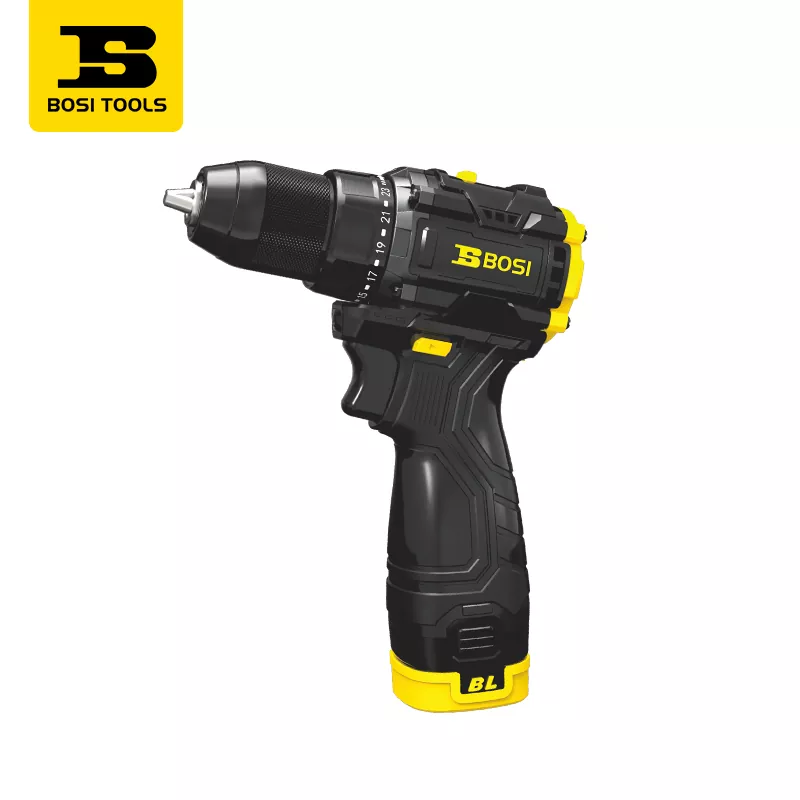
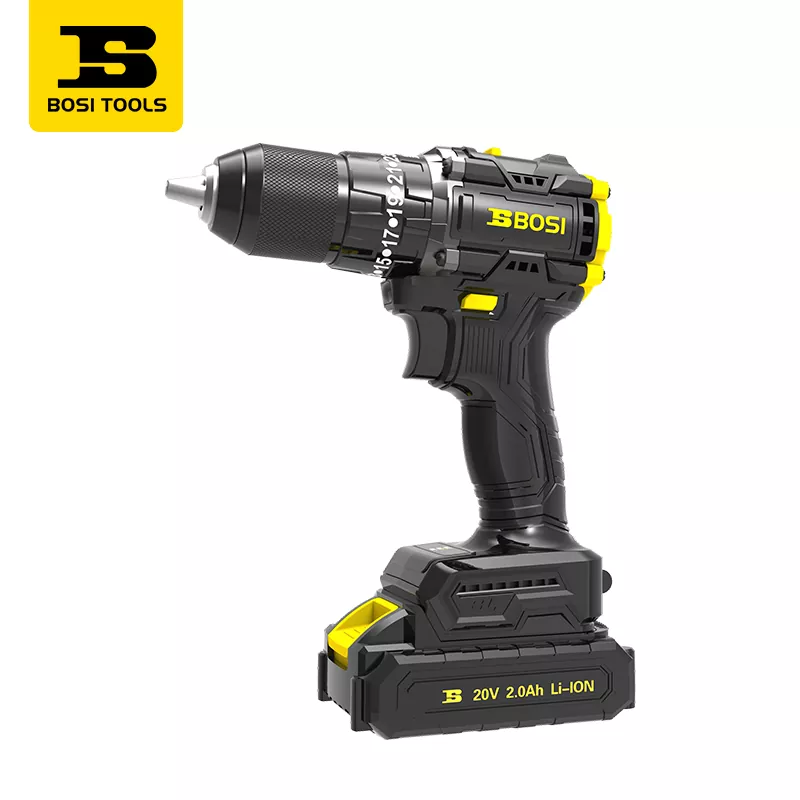
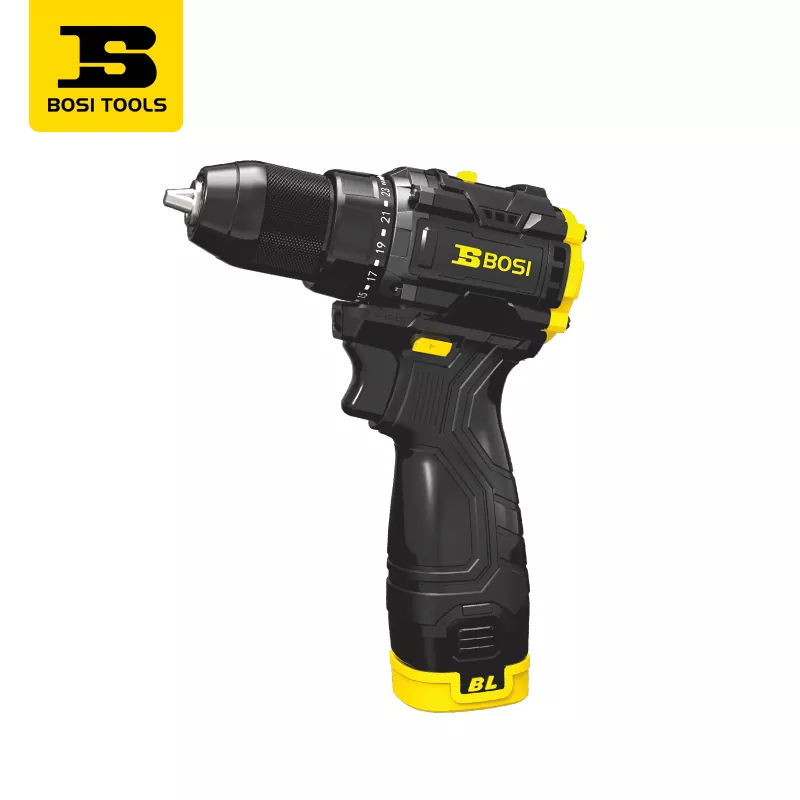
The table below compares configurations published on BOSI's Li-ion Brushless Drill and Li-ion Brushless Impact Drill pages. All three configurations are brushless. The figures describe available specifications, not a timed or endurance test.
| Specification | 16 V ordinary drill | 20 V ordinary drill | 20 V impact drill |
|---|---|---|---|
| Battery capacity | 2.0 Ah | 2.0 Ah | 2.0 Ah |
| Maximum torque | 50 N·m | 60 N·m | 60 N·m |
| No-load speed | 0–500 / 0–1800 r/min | 0–500 / 0–1800 r/min | 0–500 / 0–1800 r/min |
| Maximum clamping diameter | 10 mm | 10 mm | 13 mm |
| Published torque settings | 23+1 | 23+1 | 23+1 |
| Drilling action | Ordinary drilling | Ordinary drilling | Ordinary plus hammer drilling |
Same motor label and torque, different function
The two 20 V models both list 60 N·m, yet their chuck specifications and drilling action differ. For ordinary wood drilling and screwdriving, compare the necessary capacity and control. If suitable masonry work is included, the mechanism becomes another requirement. The shared maximum torque cannot make that decision.
The 16 V and 20 V ordinary drills list different maximum torque figures while retaining the same published speed ranges, clamping size, and 23+1 settings. Those are configuration differences to investigate on the task. The maximum torque must not be assumed available at the highest no-load speed, and the numbered clutch settings are not 23 calibrated torque values.
A factory selection view: keep changing fields visible
For a procurement review, I would put the work requirement beside each changing specification before deciding which sample to order. A secure shank fit, sufficient application rating, manageable installed weight, and useful control each answer a different question. I would keep those checks separate from the motor label.
When comparing a brushed alternative, record its exact battery, gearbox, modes, and accessory as carefully as the brushless sample. A 20 V brushless drill compared with a differently configured 16 V brushed drill is a comparison of two products. Establishing how much of the difference comes from the motor requires a controlled comparison.
Specify the bit alongside the tool. Our drill-bit types and selection guide covers material, geometry, shank, and operating mode so the accessory does not become an uncontrolled variable in the trial.
How to compare drill samples before a bulk order
I would begin with an acceptable finished result, then define the working combination used to obtain it. For a hole, that can include material, diameter, depth, position, and exit condition. For a fastener, it includes the specified fit or seating result. A trial that counts damaged work as completed work gives a misleading comparison.
Make the task repeatable
Use identified samples and their approved batteries. Keep the material, accessory specification and condition, mode, gear, and task requirement consistent where the comparison permits. Record unavoidable differences instead of hiding them. Follow each product's instructions for charge condition, cooling, and operation.
| Record field | What to enter | Why it matters |
|---|---|---|
| Sample identity | Model, sample identifier, motor declaration, and supplied configuration. | Ties the result to the product that can be ordered. |
| Battery and charger | Approved pack model, voltage designation, capacity, condition, and starting charge procedure. | Prevents an unexplained pack difference from becoming a motor claim. |
| Workpiece and accessory | Material, dimensions, bit or driver specification, condition, and fastening details. | Defines the load and expected result. |
| Operating conditions | Mode, mechanical gear, settings, environment, and work/rest sequence. | Makes the comparison interpretable and repeatable. |
| Accepted output | Acceptable holes or fastening results, rejected work, and inspection criteria. | Measures useful work instead of activity alone. |
| Time and interruptions | Task time, required pauses, battery changes, stopping behavior, and recovery procedure. | Separates cutting performance from availability. |
| Handling and controls | Installed weight, balance, access, trigger control, and stopping observations. | Captures differences a torque figure cannot describe. |
| Repeatability | Results by run and by sample, with the number of each identified. | Shows variation rather than presenting one favorable run as typical. |
Compare normal work within the rated limits
The CCOHS drill guidance calls for accessories matched to the drill and material, secure workholding, clear ventilation, and power isolation before accessory changes. It also advises staying within the manufacturer's capacity. Use those principles when setting up sample work.
Deliberately forcing a stall or bypassing protection is not a useful procurement shortcut. If the task repeatedly stops the tool, pause the trial and review the tool, pack, accessory, and operating method. Record the observation without assuming which component caused it.
Keep a performance trial separate from an endurance claim
A short comparison can help select a configuration. It does not establish a lifetime multiplier. Surface-temperature observations also need the location, timing, and method recorded; they cannot represent every internal component. For endurance evidence, define the cycle, sample count, maintenance, and end-of-life criterion separately.
What to confirm before placing a wholesale order
The configuration approved during sample evaluation should be identifiable in the order. Record the model and agreed battery, charger, chuck, operating functions, accessories, and packaging. Include a process for reviewing changes that could affect fit, performance, or service parts.
Connect the approved sample to the supply specification
Keep the sample record with the agreed product description and inspection criteria. If a component or configuration changes, determine whether the previous result still applies. A similar housing or the same printed voltage does not resolve that question.
Ask for model-specific service and documentation
Confirm the repair route, identifiable spare parts, and agreed handling arrangements. Check that any requested technical or market documentation corresponds to the exact tool, battery, charger, and destination requirements. A general company document should not be treated as model-specific product evidence.

Send a task-based enquiry
Provide the customer type, work materials, hole or fastening requirements, expected workload, preferred kit configuration, and existing battery system. State the service and documentation needs that influence the order. These details make a brushed-versus-brushless discussion specific enough to compare suitable products.
Use the official BOSI contact page or email bosi01@bosi.cn with those requirements. The BOSI company profile provides the business background alongside the model-specific product pages.
FAQs about brushed and brushless drills
Can brushed and brushless drills use the same battery?
They can share a battery only when the manufacturer approves the exact tool and pack combination. Motor type does not establish compatibility. Check the interface, electrical requirements, charger, and model-specific compatibility information before purchasing.
Can a brushless drill still overheat?
Yes. The motor windings, electronic drive, battery, and mechanical components still produce heat. Load, cooling, and operating conditions matter. Follow the tool's instructions and investigate repeated temperature-related interruptions rather than assuming the brushless label prevents them.
Does a brushless motor mean a drill has hammer action?
No. Brushless identifies the motor construction. Hammer action is a separate mechanism and operating function. Check the exact model's modes and material ratings when selecting a drill for masonry work.
Does the absence of visible sparks prove a drill is brushless?
No. External observations alone do not reliably identify the motor construction. Request a model-specific declaration and supporting technical documentation. Any further inspection should follow an appropriate authorized procedure.
What should buyers request with a longer-runtime claim?
Ask for the compared models, approved battery configurations, charge procedure, accessory, work material, task cycle, completion criteria, and results across the stated samples and runs. A percentage without those conditions cannot establish the advantage for your intended work.
Choose the configuration that earns its place in the range
A brushed drill can be a suitable purchase for a defined task and cost position. A brushless drill can justify a premium when its complete configuration delivers benefits the customer will use. Base the order on identified specifications, accepted sample results, and a workable service plan.
Related News
- Cordless Impact Wrench Buying Guide: Torque, Drive Size, and Battery Selection
- Angle Grinder Buying Guide: How to Choose Size, Power, Speed, and Discs
- Drill Bit Types and Uses: How to Choose for Wood, Metal, and Concrete
- Hammer Drill vs. Rotary Hammer: Which Do You Need for Concrete?
- Cordless Drill Buying Guide: How to Choose the Right Drill and Kit
- How to Choose Cordless Power Tools: Specs, Batteries, and Tool Systems



-
E-mail