
- English
- Español
- Português
- русский
- Français
- 日本語
- Deutsch
- tiếng Việt
- Italiano
- Nederlands
- ภาษาไทย
- Polski
- 한국어
- Svenska
- magyar
- Malay
- বাংলা ভাষার
- Dansk
- Suomi
- हिन्दी
- Pilipino
- Türkçe
- Gaeilge
- العربية
- Indonesia
- Norsk
- تمل
- český
- ελληνικά
- український
- Javanese
- فارسی
- தமிழ்
- తెలుగు
- नेपाली
- Burmese
- български
- ລາວ
- Latine
- Қазақша
- Euskal
- Azərbaycan
- Slovenský jazyk
- Македонски
- Lietuvos
- Eesti Keel
- Română
- Slovenski
- मराठी
- Srpski језик
High-Efficiency Grinding Machine Manufacturer
BOSI Tools is a grinding machine manufacturer from China, offering both the Benchtop Grinder and the Vertical Grinder. From pure copper motors to high-strength precision steel gears, and from a widened and thickened base to a quiet, noise-free design—BOSI grinding machines combine stable rotational speeds with durable structures, providing reliable grinding support for industries such as mechanical manufacturing, instrumentation, and hardware tools.
We can provide selection advice and customized solutions based on actual working conditions. Please feel free to contact us at any time.
Working Principle
The working principle of BOSI grinding machines is simple and direct: grinding wheels are mounted directly onto both ends of the pure copper motor's rotor shaft, rotating synchronously at 2,840 r/min once powered on, thereby converting the motor's rotary kinetic energy into grinding capability.
After the motor starts via a centrifugal switch, the rotor shaft drives the high-strength precision steel gears at both ends to rotate synchronously, with the grinding wheels secured to the shaft ends by flanges.
When a workpiece contacts the surface of the rotating grinding wheel, the abrasive grains on the wheel cut the workpiece material at high speed, producing fine chips and sparks. The entire series features a quiet, noise-free design to reduce grinding noise.
The widened and thickened base absorbs the micro-vibrations generated by the motor's operation, ensuring the grinding wheels run smoothly without wobbling when contacting the workpiece.
Wheel sizes range from 125mm to 250mm, with grit size and hardness matched to the model's positioning—smaller sizes are suited for fine sharpening, while larger sizes are suitable for heavy stock removal.
The Vertical Grinder has its wheel shaft mounted vertically, allowing wheels of different grits to be configured at both ends simultaneously; one side for coarse grinding and the other for fine finishing, allowing the workpiece to switch processes between the two wheels without stopping the machine.
What Materials Can Be Processed?
The grinding applications for BOSI grinding machines cover two major fields: metalworking and non-metal finishing:
1. Carbon Steel and Alloy Steel
Sharpening lathe tools, re-pointing drill bits, and edging flat chisels. The 200W/370W Benchtop models, paired with high-quality grinding wheels, are suitable for tool sharpening and deburring small workpieces. For high-hardness alloy steel, it is recommended to choose a 250mm wheel model, which offers a larger grinding area and faster heat dissipation.
2. Cast Iron and Cast Steel
Grinding casting gates and removing parting lines. The 750W Vertical model has wheels of different grits mounted simultaneously on both ends of its long shaft, enabling efficient workflow with coarse grinding on one side and fine finishing on the other.
3. Stainless Steel and Non-Ferrous Metals
Grinding stainless steel weld marks and removing burrs from copper and aluminum parts. It is necessary to switch to specialized grinding wheels suitable for the specific material to prevent the clogging that occurs with standard wheels. The 550W/750W models have ample torque reserve, maintaining speed without drop-off under heavy loads.
4. Instruments and Precision Parts
Re-sharpening small-diameter drill bits, shaping micro punches, and restoring the cutting edge of vernier calipers. The compact 125mm Benchtop model is suitable for fine work on a workbench.
5. Hardware Tool Maintenance
Restoring screwdriver tips, shaping chisel edges, and sharpening scissors. The entire series adopts a uniform speed design of 2,840 r/min, so switching between different models requires no re-adjustment of the operator's feed pressure feel.
Common Problems and Solutions
|
Common Problem |
Cause Analysis |
Solution |
Corresponding BOSI Design |
|
Low grinding efficiency, workpiece discoloration and annealing |
Dull grinding wheel or incorrect grit size; excessive feed pressure causing the workpiece to overheat |
Dress the wheel surface with a wheel dresser; choose a lower grit wheel for coarse grinding, and appropriately reduce downward pressure |
High-quality wheels have good self-sharpening properties; the all-copper motor maintains strong speed retention at a constant 2,840 r/min |
|
Wheel wobble, high vibration |
The wheel was installed off-center or the flange is loose; uneven wear around the wheel circumference after prolonged use |
Correct the flange mounting to ensure flatness, and observe for no wobble during a trial run; use a dresser to true the wheel before use |
The widened and thickened base absorbs vibration; high-strength precision steel gears have high meshing accuracy |
|
Motor fails to start |
Power supply not connected or switch malfunction; oxidized contacts on the centrifugal switch |
Check the power supply and plug; the centrifugal switch requires professional inspection and replacement |
The pure copper motor start winding has ample margin; the centrifugal switch contacts are silver-plated to resist oxidation |
|
Wheel shattering and flying fragments |
The wheel has been impacted or is damp; the rotational speed exceeds the wheel's rated value |
Before mounting, tap the wheel and listen—only use if the sound is clear with no dullness; run idle for 30 seconds; exceeding the rated speed is strictly prohibited |
Wheel dimensions and speed are strictly matched; the guard provides full-enclosure protection |
|
Base instability, machine head shaking |
The workbench surface is uneven, or the base bolts are not tightened |
Use rubber shims to level the four corners of the base; tighten all mounting bolts |
The widened and thickened base has a low center of gravity; the cast base is vibration-resistant and stable |
How to Choose the Right Grinding Machine?
|
Selection Dimension |
MD-T125 Benchtop |
MD-T150 Benchtop |
MD-T200 Benchtop |
MD-T250S Benchtop |
MD-L250S Vertical |
|
Power |
200W |
370W |
550W |
750W |
750W |
|
Wheel Size |
125mm |
150mm |
200mm |
250mm |
250mm |
|
Voltage |
220V |
220V |
220V |
380V |
380V |
|
Recommended Scenarios |
Fine sharpening, micro tool maintenance, deburring instrument parts |
Household tool sharpening, chamfering small workpieces |
Workshop staple, drill bit and lathe tool sharpening, weld mark grinding |
Heavy stock removal, casting gate grinding, chamfering large workpieces |
Batch grinding in mechanical manufacturing, instrumentation, and hardware tool industries |
The selection is based on the workpiece size and grinding frequency. For fine sharpening and home scenarios, the 125mm/200W or 150mm/370W Benchtop models are lightweight and energy-efficient. For workshop tool sharpening and workpiece deburring, the 200mm/550W model is the workhorse, with a balanced match of wheel area and power.
For heavy-duty grinding or chamfering large workpieces, the 250mm Benchtop model offers a wide wheel and sufficient power. If batch grinding is required and workflow efficiency is a priority, the Vertical model, with two wheels operating simultaneously at both ends, can be configured with different grits for coarse and fine work, making it suitable for the mechanical manufacturing and hardware tool industries.
Safety Precautions for Use
1. Personal Protective Equipment
Safety goggles or a face shield must be worn when operating a grinding machine; the direction of the grinding sparks must not face anyone. Wear a dust mask, as dry grinding metal dust is harmful to the respiratory tract. Wearing gloves while operating a benchtop grinder is strictly prohibited to prevent the gloves from being caught in the rotating wheel.
2. Wheel Mounting and Inspection
Before mounting a new wheel, lightly tap its side with a wooden hammer and listen; use it only if the sound is clear and not dull. A soft spacer must be placed between the flange and the wheel, and the securing nut should be tightened moderately; over-tightening will crack the wheel. After mounting, run the machine idle for more than 2 minutes and confirm there is no abnormal vibration before starting work.
3. Work Rest and Clearance
Maintain a clearance of 2-3mm between the grinding wheel and the work rest. Adjust the work rest periodically as the wheel wears. An excessive gap can cause the workpiece to wedge between the wheel and the rest, leading to wheel breakage.
4. Operating Posture
Stand to the side of the grinding machine while operating it, keeping your body out of the plane of rotation. This way, even in the unlikely event of a wheel shattering, you will not be hit directly. When grinding, hold the workpiece firmly and steadily, apply light contact with the wheel surface, and move it evenly. Banging the workpiece hard against the wheel is strictly prohibited. Never use the side of the grinding wheel for grinding unless the specific model explicitly permits it.
5. Environment and Power Supply
Keep the work area dry and clean. 220V models must be reliably grounded. The 380V Vertical model must be wired by a professional electrician. The direction of wheel rotation must never be aimed at power cords or air/gas lines. Place the Benchtop model on a stable workbench, and secure the Vertical model to the floor using anchor bolts.
6. Maintenance and Replacement
When the two grinding wheels have worn down to a point where their diameter difference exceeds 10%, they should be replaced simultaneously to maintain symmetrical balance. Store grinding wheels in a dry place to prevent moisture absorption. Annually, apply high-temperature-resistant grease to the gearbox. Regularly check the carbon brush length and clean the ventilation slots on the housing.
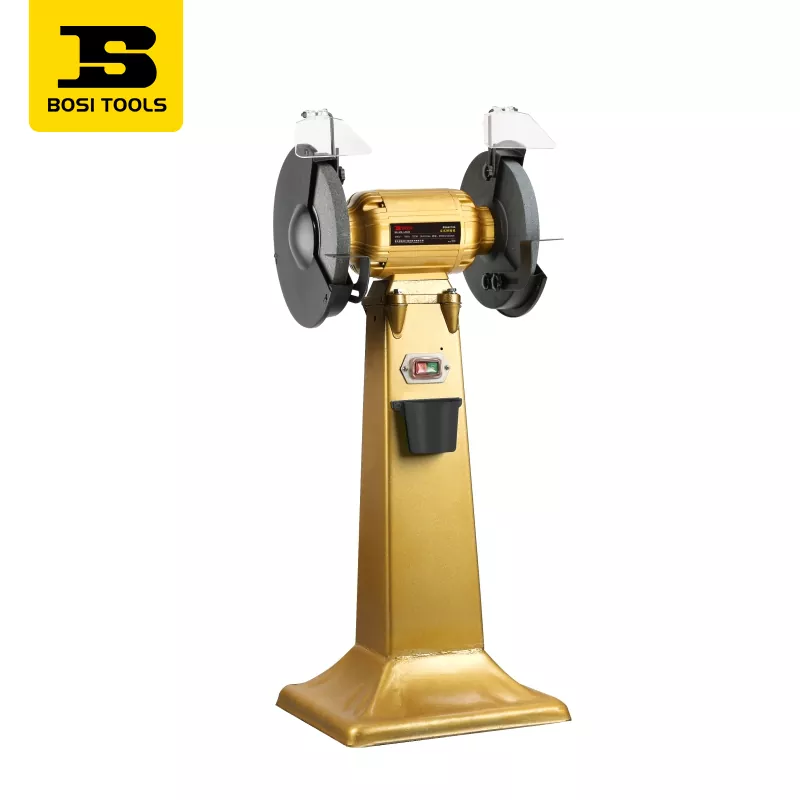
Vertical Grinding Machine
This is the MD-L250S vertical grinding machine from the Chinese manufacturer BOSI. It features a 750W motor, a 250mm diameter grinding wheel, 380V voltage, and a no-load speed of 2840 rpm. It is suitable for grinding operations in industries such as machinery manufacturing, instrumentation, and hardware tools. It boasts a robust vertical structure, high efficiency, and stability. Inquiries and samples are welcome.
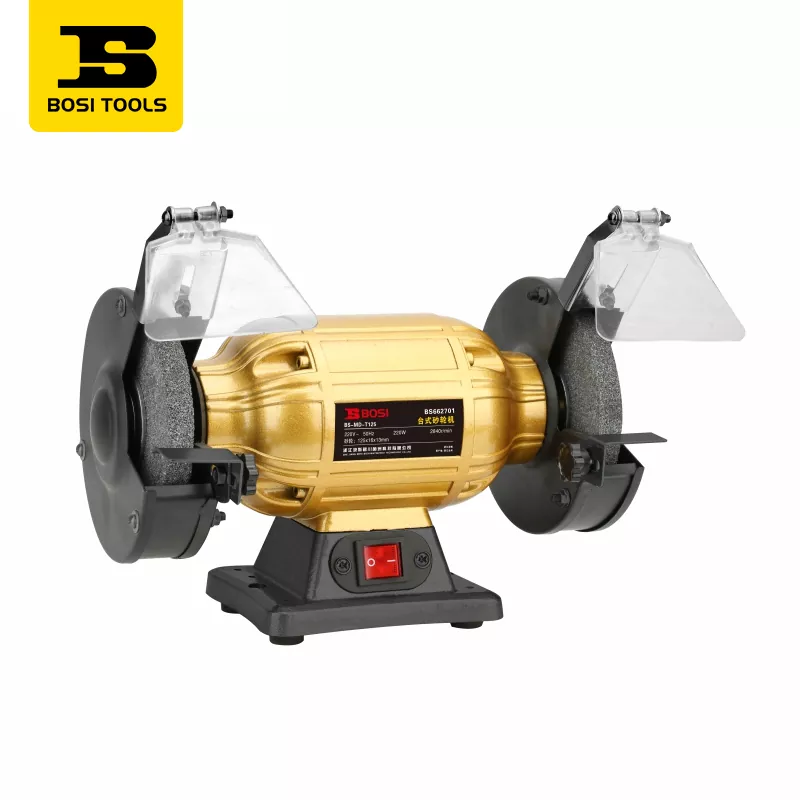
Benchtop Grinder
BOSI is a reliable factory of Benchtop Grinder series, our products have grinding wheel diameters ranging from 125-250mm and power from 200-750W. Pure copper motors provide powerful performance and a quiet, noise-free design. High-quality grinding wheels, high-strength steel gears, and a widened, thickened base ensure durability. Suitable for tool sharpening, workpiece deburring, and metal grinding. Contact us for direct price.


-
E-mail