
- English
- Español
- Português
- русский
- Français
- 日本語
- Deutsch
- tiếng Việt
- Italiano
- Nederlands
- ภาษาไทย
- Polski
- 한국어
- Svenska
- magyar
- Malay
- বাংলা ভাষার
- Dansk
- Suomi
- हिन्दी
- Pilipino
- Türkçe
- Gaeilge
- العربية
- Indonesia
- Norsk
- تمل
- český
- ελληνικά
- український
- Javanese
- فارسی
- தமிழ்
- తెలుగు
- नेपाली
- Burmese
- български
- ລາວ
- Latine
- Қазақша
- Euskal
- Azərbaycan
- Slovenský jazyk
- Македонски
- Lietuvos
- Eesti Keel
- Română
- Slovenski
- मराठी
- Srpski језик
Li-ion Reciprocating Saws Factory Direct Supply
BOSI Tools is a Li-ion reciprocating saw manufacturer from China, offering both the Li-ion Brushless Reciprocating Saw and the Li-ion Cordless Reciprocating Saw.
A 600W brushless motor delivers powerful performance, paired with a 20mm reciprocating stroke and a quick-change system for multi-purpose use — BOSI breaks free from the constraints of power cords with lithium-ion portability, providing flexible and efficient sawing solutions for garden pruning, metal cutting, and renovation demolition.
We can provide selection advice and customized solutions based on actual working conditions. Please feel free to contact us at any time.
What Materials Can Be Processed?
BOSI Li-ion reciprocating saws can handle a variety of material cutting needs, from gardens to construction sites:
● Wood and Wood-Based Panels
The Li-ion Brushless Reciprocating Saw, with its 20mm reciprocating stroke and 600W motor, can cut squared timber, plywood, particleboard, and wooden joists.
The Li-ion Cordless Reciprocating Saw, with its lightweight 12V body, is suitable for cutting joinery boards and decorative moldings. Choose coarse-tooth blades to improve chip ejection efficiency.
● Metal Pipes and Profiles
Cutting steel pipes, angle iron, copper pipes, and aluminum profiles. The brushless model's low speed of 1,700 strokes per minute and high torque, paired with a fine-tooth metal cutting blade, delivers a flat cut without curling the edge.
The cordless model, at a high frequency of 2,400 strokes per minute, is suitable for quickly cutting thin-walled pipes.
● PVC and Plastic Pipes
Cutting drainage pipes, conduit pipes, and PVC profiles. The quick-change system allows blades to be swapped in seconds, making it easy to cut with a single tool for multiple purposes.
Simply use a universal-pitch blade, leaving a smooth cut without burrs.
● Branches and Garden Pruning
Thinning fruit tree branches and shaping shrubs in the garden. The Li-ion Brushless version is completely free from power cords, allowing flexible operation outdoors.
Use a coarse-tooth blade to quickly saw through wet wood and live branches.
● Gypsum Board and Renovation Demolition
Making openings in gypsum board, and dismantling old door and window frames.
The compact 12V cordless body reaches into narrow spaces, and a specialized blade prevents tearing of the gypsum board.
How to Choose the Right Li-ion Reciprocating Saw?
|
Selection Dimension |
Li-ion Cordless Reciprocating Saw 12V |
Li-ion Brushless Reciprocating Saw 20V |
|
Motor & Power |
360W powerful motor |
600W brushless motor |
|
Battery Configuration |
12V/1.5Ah |
20V/4.0Ah |
|
No-Load Speed |
0-2,400 strokes/min |
0-1,700 strokes/min |
|
Reciprocating Stroke |
13mm |
20mm |
|
Weight & Portability |
Compact body, lightweight and durable |
Compact body, long-lasting runtime |
|
Recommended Scenarios |
Cutting thin panels, shearing PVC pipes, fine renovation work |
Cutting squared timber, metal profiles, garden pruning, demolition work |
The primary criteria for selection are cutting thickness and material. For lightweight cutting of thin panels, PVC pipes, and gypsum board, the 12V cordless model offers a compact body and flexible operation.
For squared timber, metal pipes, and branches that require a larger stroke and sustained power, the 20V brushless model with its 20mm stroke and 600W power cuts without difficulty. The quick-change system is common to both models; simply select the appropriate blade based on the material.
Common Problems and Solutions
|
Common Problem |
Cause Analysis |
Solution |
Corresponding BOSI Design |
|
Low cutting efficiency, saw blade vibrating |
Dull blade or not locked securely; excessive clearance in the reciprocating shaft |
Replace with a blade suitable for the material, check that the quick-change mechanism is locked securely |
The quick-change system swaps blades in seconds; the reciprocating shaft fits with precision and stability |
|
Saw blade binding or breaking |
Applying lateral force during cutting, or mismatched blade specification |
Push and pull in a straight line along the blade's direction, without lateral bending; choose the correct tooth pitch for the material |
The brushless motor provides high torque at low speed for smooth, jam-free cutting |
|
Insufficient battery runtime |
Continuous heavy-duty cutting or aging battery |
Rotate between two batteries; store with a 30%–50% charge |
The brushless model features a high-capacity 4.0Ah battery for long-lasting runtime |
|
Tool body overheats and shuts down |
Continuous overloaded operation or blocked ventilation slots |
For heavy cutting, use intermittently; clean dust from the ventilation slots |
The powerful motor efficiently dissipates heat; the brushless motor has a lower temperature rise |
|
Rough cut, large burrs |
Mismatched blade tooth pitch, or feeding speed too fast |
Use a coarse-tooth blade for thick stock and a fine-tooth blade for thin stock; feed at a constant speed without forcing |
One tool for multiple purposes, compatible with blades for various materials; quick-change for convenient switching |
Our Li-ion Reciprocating Saws vs. Other Brands: Why Choose BOSI?
|
Comparison Dimension |
BOSI Li-ion Reciprocating Saws |
Same-Price Generic Brands |
Imported High-End Brands |
|
Motor & Power |
The brushless model features a 600W powerful motor; the cordless model is 360W |
Aluminum-wire motors with inflated power ratings; speed drops severely under load |
Mature brushless technology, but the price is 2–3 times higher for the same specifications |
|
Battery & Runtime |
High-capacity 20V/4.0Ah; the 12V is lightweight and portable |
Inflated battery capacity; short cycle life |
High battery quality, but the unit price for a single battery is expensive |
|
Quick-Change System |
The quick-change reciprocating shaft swaps blades in seconds, allowing one tool to easily handle multiple tasks |
Tools are needed to change blades, making it inefficient |
Quick-change is a mature feature, but the brand premium is significant |
|
Stroke & Efficiency |
The brushless model has a large 20mm stroke; the cordless model has a 13mm high-frequency stroke |
Short stroke, slow cutting |
Large stroke, high efficiency, commands a professional-grade premium |
|
Overall Cost Effectiveness |
Delivers a brushless motor, high-capacity battery, and quick-change system at a mid-range price point |
Low price, but short motor life and non-standard blade interfaces |
Top-tier quality, suitable for ultra-high-frequency professional use |
The BOSI Li-ion Reciprocating Saw is centered on a high-power brushless motor and a 20mm reciprocating stroke.
Combined with a quick-change system and a multi-purpose design, it establishes a clear advantage over generic brands in portability and cutting efficiency.
Safety Precautions for Use
1. Battery Safety
Use the original charger for charging. Protect the battery from high-temperature exposure and immersion in water. Store with a 30%–50% charge.
Check the battery level before starting work to prevent unexpected power loss mid-task.
2. Blade Installation
When changing blades using the quick-change system, ensure the locking mechanism is fully engaged. Before starting, pull gently on the blade to confirm it is secure.
The direction of the blade teeth must face toward the front of the tool; reverse installation will result in ineffective cutting.
3. Operating Posture
Hold the tool with both hands. During cutting, keep the base plate firmly against the workpiece to reduce vibration.
The blade's motion extends both forward and backward; stand to the side of the tool body, keeping your hands away from the blade path. When cutting metal, wear safety goggles to protect against flying debris.
4. Material Matching
Use the appropriate blade for the material being cut — coarse-tooth blades for wood and branches, fine-tooth blades for metal and PVC.
Using a wood blade to cut metal is strictly prohibited, as it will cause the blade to overheat, anneal, or chip its teeth.
5. Cutting Control
Do not let the blade touch the workpiece before starting the tool; only begin feeding at a constant speed after it has reached full speed.
When cutting thick stock, the reciprocating saw itself generates significant vibration; maintain a steady advance without forcibly bending it sideways. Only set the tool down after the blade has come to a complete stop.
6. Maintenance and Storage
After work, clean accumulated dust from the housing ventilation slots and the blade clamping area. If not using the tool for an extended period, remove the battery and store it separately, recharging it once a month.
When storing blades, apply anti-rust oil and prevent the tooth tips from being knocked and damaged. Inspect the tightness of the reciprocating shaft's clamping mechanism quarterly.
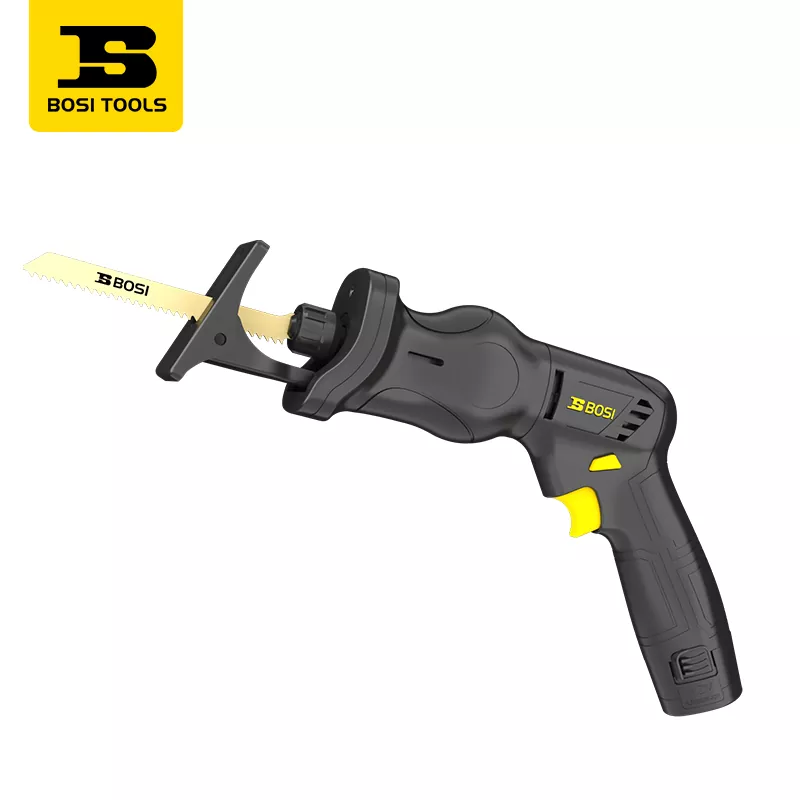
Li-ion Cordless Reciprocating Saw
The BOSI Black Warrior Cool Motion series rechargeable Li-ion Cordless Reciprocating Saw, from our China factory, features a 12V/1.5Ah battery, a 360W motor, a no-load speed of 0-2400 cycles/min, and a 13mm reciprocating stroke. It includes a quick-release reciprocating lever, making it versatile, lightweight, and portable. Suitable for home repairs, wood cutting, metal pipe sawing, etc.
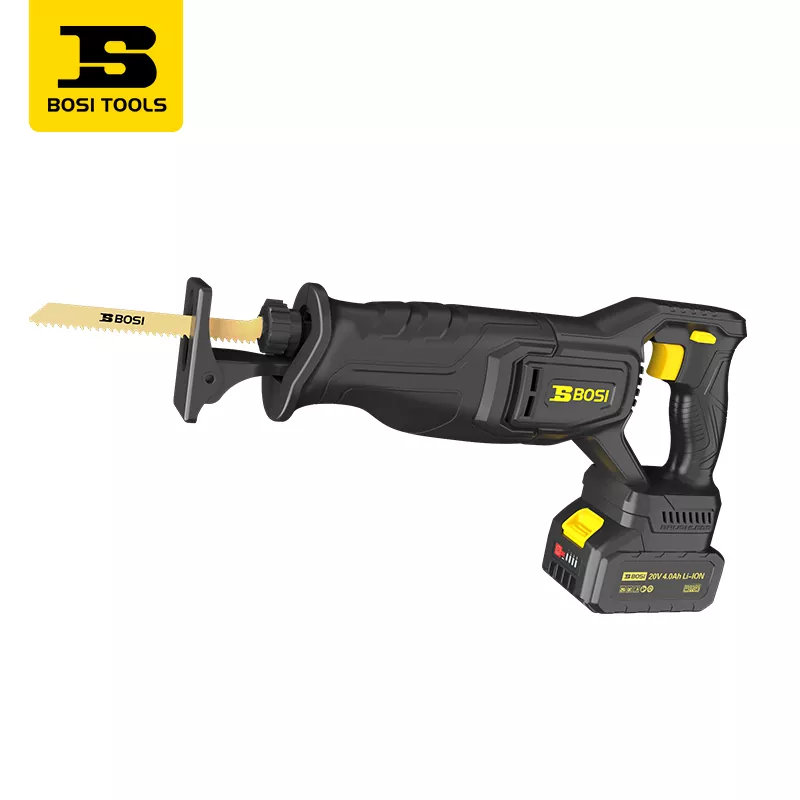
Li-ion Brushless Reciprocating Saw
The Black Warrior Cool Series Li-ion Brushless Reciprocating Saw is offered by BOSI Tools, a professional manufacturer in China. It is 20V/4.0Ah, 600W motor, no-load speed 0-1700 rpm/min, 20mm reciprocating stroke. Brushless motor, quick-release reciprocating lever, multi-purpose. Suitable for pipe cutting, wood sawing, metal sawing, etc.
-
E-mail