
- English
- Español
- Português
- русский
- Français
- 日本語
- Deutsch
- tiếng Việt
- Italiano
- Nederlands
- ภาษาไทย
- Polski
- 한국어
- Svenska
- magyar
- Malay
- বাংলা ভাষার
- Dansk
- Suomi
- हिन्दी
- Pilipino
- Türkçe
- Gaeilge
- العربية
- Indonesia
- Norsk
- تمل
- český
- ελληνικά
- український
- Javanese
- فارسی
- தமிழ்
- తెలుగు
- नेपाली
- Burmese
- български
- ລາວ
- Latine
- Қазақша
- Euskal
- Azərbaycan
- Slovenský jazyk
- Македонски
- Lietuvos
- Eesti Keel
- Română
- Slovenski
- मराठी
- Srpski језик
High-Performance Electric Hammer Supplier
BOSI Tools is an electric hammer manufacturer from China, offering both the Safety Clutch Electric Hammer and the Conventional Electric Hammer, specifically designed for heavy-duty construction tasks such as concrete drilling, brick wall slotting, and stone breaking. For model selection or customized configurations tailored to specific application scenarios, please contact our professional team.
Working Principle
The core operating logic of BOSI electric hammers is to convert the motor's rotary motion into a compound action of piston reciprocating impact and drill bit rotation. Once powered, a high-quality pure copper motor drives a crank-and-connecting-rod mechanism through a gear set, causing the piston to reciprocate at high speed within the cylinder.
As the piston compresses air, the air cushion propels the striker to forcefully hit the beat piece, which then transmits the impact force to the tail of the drill bit, generating an axial pulse strike. Simultaneously, another power path from the motor drives the chuck rotation via bevel gears, causing the drill bit to rotate synchronously.
The Safety Clutch Electric Hammer incorporates an additional torque overload protection mechanism in the drive train: when the drill bit encounters rebar and becomes stuck, the clutch instantly disengages, cutting off power transmission and achieving an "auto-stop on rebar" function. This both protects the operator's wrist from recoil and prevents gearbox tooth breakage.
The 1150W Safety Clutch model combines a speed of 960 r/min with this clutch mechanism, while the 900W Conventional Electric Hammer flexibly switches between three functions: hammering, drilling, and chiseling. Both models utilize a spring-cushioned structure to absorb housing recoil, concentrating impact energy on the drill bit rather than transmitting it to the grip area.
Common Problems During Operation and Solutions
|
Common Problem |
Cause Analysis |
Solution |
Corresponding BOSI Design |
|
Drill bit stuck and cannot be extracted |
Bit has hit rebar or is jammed by concrete dust |
Immediately release the switch, attempt to reverse rotation to withdraw; do not forcibly twist the tool body |
Safety Clutch Electric Hammer automatically stops and releases force when hitting rebar; single-direction dual-function models reverse out |
|
Noticeable decrease in drilling efficiency |
Worn drill bit or loose chuck; poor dust removal |
Check if the carbide tip is blunt and replace if necessary; regularly clean dust from inside the chuck |
High-quality chuck maintains good concentricity; Safety Clutch model’s spring-cushioned structure indirectly assists dust removal |
|
Abnormal body vibration or unusual noise |
Bent drill bit or chuck wear; insufficient internal cylinder lubrication |
Replace with a qualified drill bit; check chuck clearance, and if necessary send for maintenance |
Optimized heat dissipation structure design, spring-cushioned vibration-damping mechanism reduces grip fatigue |
|
Motor head overheats too quickly |
Blocked ventilation slots or continuous overloaded operation |
Stop the tool and clean dust, ensuring the air duct is clear; for heavy-duty tasks, work intermittently, running idle to cool down |
Safety Clutch Electric Hammer has an optimized heat dissipation structure; pure copper motor’s inherent temperature rise control is better than aluminum wire motors |
|
Mode switching does not engage properly |
Forcing a mode change when gears are not fully meshed |
When switching modes, gently rotate the chuck to assist gear alignment; switching while the motor is running is strictly prohibited |
The 900W three-function model features a clear mode adjustment mechanism; the round shank quick-change chuck makes switching convenient |
Our Electric Hammer Products vs. Other Brands: Why Choose BOSI?
|
Comparison Dimension |
BOSI Electric Hammers |
Same-Price Generic Brands |
Imported High-End Brands |
|
Core Safety Configuration |
Safety Clutch model equipped with an auto-stop mechanism for rebar; when the bit hits rebar, the clutch instantly disengages, protecting the wrist and gearbox |
Vast majority have no safety clutch; when the bit binds, the recoil force is directly transmitted, easily causing wrist injury or gear tooth damage |
High-end models may feature a safety clutch, but priced 2-3 times higher |
|
Motor Materials |
All models use high-quality pure copper motors; the 1150W Safety Clutch model continuously outputs at 960 r/min; the 900W model runs at 1150 r/min |
Mostly aluminum wire motors; nominal power is inflated, and under heavy load they heat up quickly and are prone to burning out |
All-copper motors with conservative power ratings, but after-sales replacement parts are costly |
|
Functional Configuration |
The 900W Conventional Electric Hammer offers three functions: hammering, drilling, and chiseling, with a round shank two-flat two-slot quick-change chuck; the Safety Clutch model offers dual-function switching with a spline drive chuck |
Multiple functions are claimed, but the chiseling force is insufficient, and the mode switching mechanism is prone to sticking |
Comprehensive functions and smooth switching, but the premium for equivalent functional configurations is significant |
|
Heat Dissipation & Durability |
The Safety Clutch model features an optimized heat dissipation structure; the spring-cushioned vibration-damping mechanism reduces vibration transmission to the body |
Simple air ducts; housing temperature rises significantly during continuous work; insufficient sealing easily allows dust ingress |
Mature heat dissipation design, but rubber seals require frequent replacement as they age |
|
Overall Cost Effectiveness |
Delivers core configurations such as the safety clutch, pure copper motor, and multi-mode switching at a mid-range price point |
Low initial cost, but short service life and high failure rate; total cost of repeated replacements eventually exceeds |
Outstanding quality, but the entry barrier is high, making it less economical for small to medium construction teams |
The core competitiveness of BOSI electric hammers lies in implementing key configurations—such as safety clutch protection, pure copper motors, and multi-mode functionality—at a more pragmatic price, while also maintaining the same level of detail in heat dissipation structure and vibration damping without any downgrade.
How to Choose the Right Electric Hammer?
Make your decision between the Safety Clutch Electric Hammer and the Conventional Electric Hammer based on practical usage scenarios:
1. Consider Jobsite Safety Needs
If drilling into concrete structures with dense rebar, or if the internal reinforcement layout is uncertain during renovation of older buildings, prioritize the Safety Clutch Electric Hammer.
The 1150W spline drive model automatically stops rotating when it hits rebar, preventing recoil injuries and making it suitable for tasks with high safety demands.
The Conventional Electric Hammer lacks this mechanism and is better suited for standardized drilling on new construction sites where the rebar positions are clearly known.
2. Consider Functional Requirements
Do you need just a single drilling function, or multiple scenario switching? The dual-function Safety Clutch Electric Hammer focuses on rotary hammer drilling and safety protection, making it suitable for dedicated drilling tasks.
The 900W three-function Conventional Electric Hammer adds an electric chiseling function, allowing it to handle light demolition and slotting as well, offering a wider range of applications. Its round shank two-flat two-slot chuck also makes changing bits more convenient.
3. Consider Power and Drilling Capacity
Both models have a 26mm drilling diameter capacity. The 1150W Safety Clutch model emphasizes sustained power output under safety protection, with a speed of 960 r/min matched with spline drive bits.
The 900W Conventional model, with its 1150 r/min speed and three functions, delivers excellent efficiency for everyday home renovation and light commercial work.
4. Consider Grip and Vibration Damping
The Safety Clutch Electric Hammer is equipped with a spring-cushioned structure and an anti-slip handle, providing noticeable vibration reduction during prolonged drilling.
The Conventional Electric Hammer also features an ergonomic grip design and is lightweight and flexible.
Safety Precautions for Use
1. Personal Protective Equipment
When operating an electric hammer, safety goggles and a dust mask must be worn. Concrete drilling generates a large amount of dust; it is recommended to use a dust extraction system in enclosed spaces. Wear earplugs to protect against prolonged exposure to impact noise.
2. Bit Inspection and Installation
Before use, confirm that the carbide tip of the drill bit is free of cracks and the shank is not bent. Insert spline drive bits into the chuck fully and confirm they are locked. For round shank bits with two flats and two slots, align them with the detent and rotate to click into place. The use of non-specialized bits is strictly prohibited.
3. Note for the Safety Clutch Model
The automatic stop of the Safety Clutch Electric Hammer upon hitting rebar is a protective action. When this occurs, immediately release the switch, manually reverse the bit to withdraw it, and never forcefully hold the switch attempting to continue drilling after the clutch has disengaged. Otherwise, repeated disengagement impacts will accelerate wear on the clutch mechanism.
4. Power Supply and Grounding
For 220V~ models, ensure proper grounding. For outdoor or wet conditions, always use a leakage protector. Keep the power cord behind you during operation to prevent it from being damaged by the rotating bit or falling objects.
5. Operating Posture
Hold the tool with both hands, keep your feet apart for stability, and maintain the drill bit perpendicular to the wall when drilling. Avoid standing with your weight shifted to one side on a ladder; for work at heights, wear a safety harness.
6. Duty Cycle and Heat Dissipation
Heavy-load drilling should not exceed 15 minutes of continuous operation. Stop the tool and let it run idle to assist cooling. Regularly clean the ventilation slots and the chuck area to keep the heat dissipation pathways clear.
7. Switching Modes
Always stop the tool completely before switching functions. Switching between hammering, drilling, and chiseling modes while the motor is running is strictly prohibited. Never use the hammer or chisel
Three-Function Drill Hammer
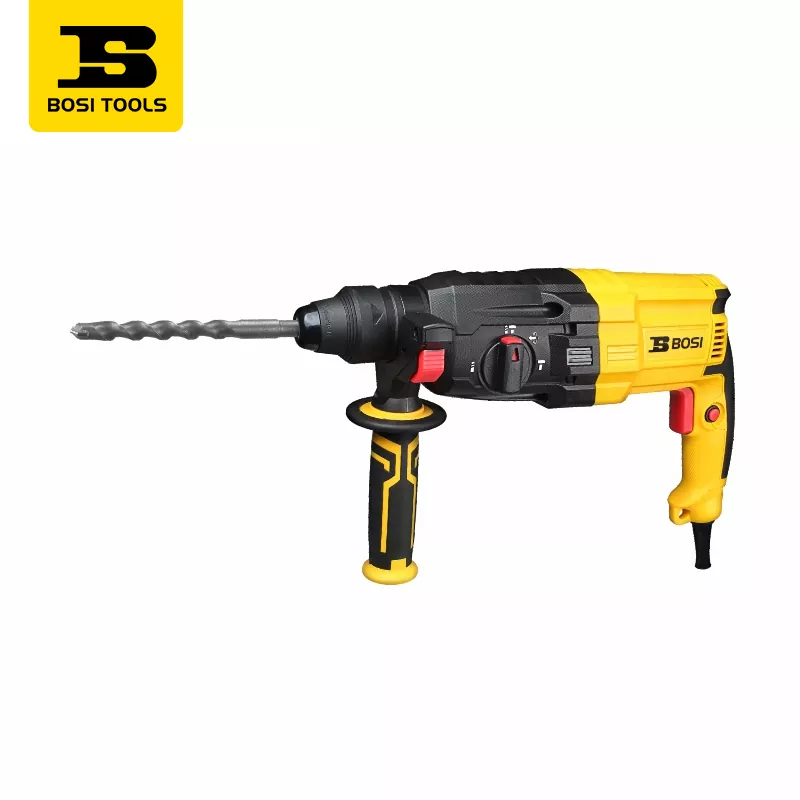
If you are looking for Three-Function Drill Hammer, BOSI Tools is a reliable manufacturer. Our hammer is rated at 900W, with a drilling diameter of 26mm. It features a three-function design (hammer, drill, and pickaxe) and a round shank chuck. Optimized heat dissipation structure, high-quality pure copper motor, and a no-load speed of 1150 rpm. Suitable for concrete drilling, wall grooving, and light demolition. New product launch, inquiries and samples welcome.
Safety Clutch Electric Hammer
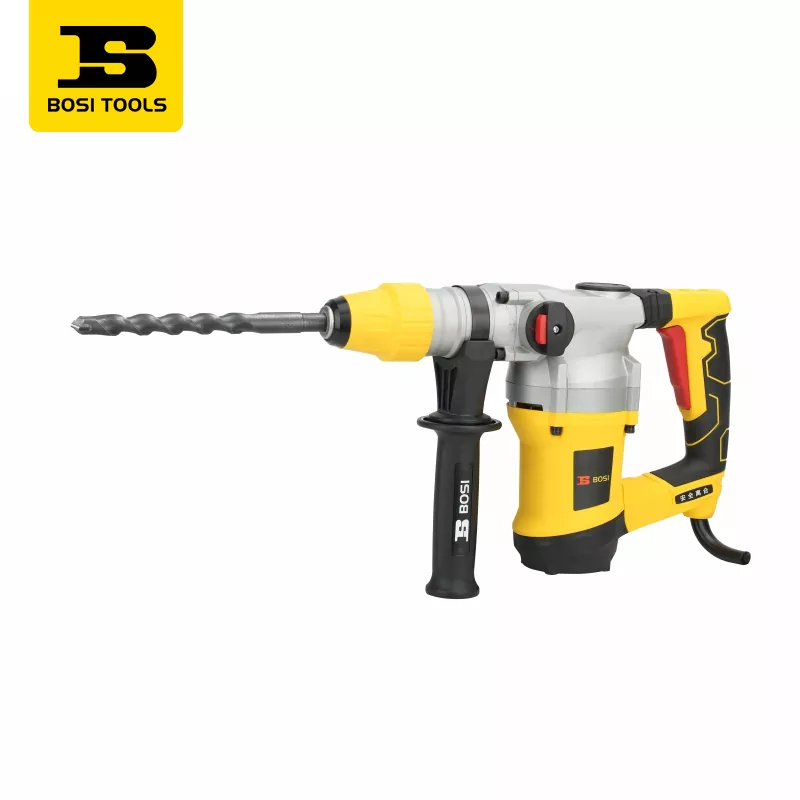
Choose BOTI Tools as your supplier, our safety clutch electric hammer features a high power output of 1150W and a drilling diameter of 26mm. Its safety clutch design automatically stops when hitting rebar and reverses to prevent hand injury. It boasts a high-quality pure copper motor with optimized heat dissipation, spring-loaded shock absorption, and a user-friendly, non-slip handle. Available in single-function or dual-function versions, it's suitable for drilling concrete, brick walls, and stone. Contact us for a quote today.
-
E-mail