
- English
- Español
- Português
- русский
- Français
- 日本語
- Deutsch
- tiếng Việt
- Italiano
- Nederlands
- ภาษาไทย
- Polski
- 한국어
- Svenska
- magyar
- Malay
- বাংলা ভাষার
- Dansk
- Suomi
- हिन्दी
- Pilipino
- Türkçe
- Gaeilge
- العربية
- Indonesia
- Norsk
- تمل
- český
- ελληνικά
- український
- Javanese
- فارسی
- தமிழ்
- తెలుగు
- नेपाली
- Burmese
- български
- ລາວ
- Latine
- Қазақша
- Euskal
- Azərbaycan
- Slovenský jazyk
- Македонски
- Lietuvos
- Eesti Keel
- Română
- Slovenski
- मराठी
- Srpski језик
China Professional Air Compressor Manufacturer
BOSI Tools is an air compressor manufacturer from China, offering both Oil-Free Air Compressors and Belt-Driven Air Compressors. All-copper-wire motors, Q235 steel air tanks, and low-noise operation—these configurations run throughout the entire BOSI air compressor range, solving the essential need for a stable air supply in pneumatic operations such as woodworking nailers, spray painting, and pneumatic pick driving through solid material usage.
We provide one-on-one selection guidance and customized services. Inquiries by phone or online are welcome.
Our Air Compressor Products vs. Other Brands: Why Choose BOSI?
|
Comparison Dimension |
BOSI Air Compressors |
Same-Price Generic Brands |
Imported High-End Brands |
|
Motor & Energy Efficiency |
The entire series uses high-efficiency all-copper-wire motors, fully covering a power range from 600W to 15 kW, with high electrical conductivity and low temperature rise |
Mostly aluminum-wire motors; nominal power does not match actual output; prone to overheating during continuous operation |
High energy efficiency ratings, but the procurement cost for the same specifications is several times higher |
|
Air Tank Quality |
Standard Q235 steel plate air tanks, tested to pressure vessel standards, with standardized welding processes |
Thinned metal sheets, uneven welds, posing a safety risk under long-term pressure |
Superior quality, complete certifications, but with a high price barrier |
|
Core Valve Components |
Copper check valves + electromagnetic valve automatic unloading; pressure switch safely trips for 100,000 cycles; the sealed check valve prevents motor burnout |
Iron valve components are prone to rust and seizing; unstable unloading leads to starting under pressure and motor burnout |
High precision and long life of valve components, but the unit replacement price is expensive |
|
Quiet Performance |
The entire Oil-Free series is designed for low noise, suitable for indoor home renovation, clinics, and other quiet-sensitive scenarios |
High noise levels, noticeable housing resonance during operation |
Mature noise reduction technology, but the functional redundancy is uneconomical |
|
Durable Structure |
The Belt-Driven type uses a ductile iron crankshaft + high-strength cylinder piston for long wear life; the Oil-Free type features an extended connecting rod for a large displacement and quick air delivery |
Low-grade crankshaft material, early wear of piston rings, rapid decay in exhaust volume |
Industrial-grade durability, suitable for 24-hour continuous operation conditions |
|
Overall Cost Effectiveness |
Delivers core configurations such as all-copper-wire motors, Q235 steel air tanks, and copper check valves at a pragmatic price |
Low initial investment, but a high failure rate, air tank safety risks, and frequent replacements cause total costs to eventually exceed the alternative |
Top-tier quality, suitable for professional factories with heavy continuous air usage |
BOSI air compressors pair all-copper-wire motors with Q235 steel air tanks, copper check valves, and automatic unloading control, approaching industrial-grade standards in noise performance and safety reliability, allowing small to medium processing factories and renovation teams to obtain a stable air supply with a reasonable investment.
How to Choose the Right Air Compressor?
|
Selection Dimension |
Oil-Free Quiet Air Compressor |
Belt-Driven Air Compressor |
|
Power & Exhaust Volume Range |
600W/110L/min to 1.68 kW ×5 / 1100L/min |
2.2 kW/250L/min to 15 kW/2.0m³/min |
|
Air Tank Volume |
9L to 300L |
70L to 430L |
|
Voltage Standard |
Mainly 220V (large models support 380V) |
Mainly 380V (V-0.25/8 single-phase model supports 220V) |
|
Typical Air Delivery Time |
30S (15L) to 150S (180L) |
Continuous and stable exhaust, large air storage capacity |
|
Recommended Scenarios |
Woodworking nailers, spray painting, home renovation pneumatics, dental clinics, laboratories, and other scenarios requiring quiet and clean air supply |
Pneumatic pick driving, high-torque pneumatic wrenches for auto repair, centralized factory air supply, spray painting workshops, and other high-intensity continuous air usage scenarios |
The selection logic depends on the air consumption volume and the working environment.
For intermittent, small-volume operations (nailers, dust blowing, model painting), a 600W/1380W unit paired with a 9L-30L air tank is sufficient for quick air delivery and instant use.
For continuous, medium-flow operations (furniture painting, multiple spray guns used simultaneously), a 1380W ×2 or ×3 configuration with a 50L-90L tank, delivering an exhaust volume of 420L-630L/min, ensures that multiple guns do not experience pressure drops.
If driving high-consumption tools like pneumatic picks or heavy-duty pneumatic wrenches, you must choose the Belt-Driven type: 2.2 kW-4 kW covers 250-600L/min, paired with 70L-105L tanks, to satisfy single-gun intermittent use.
Only models at or above 7.5 kW, with an exhaust volume of 900L/min or higher and a tank volume of 180L or larger, can stably drive a pneumatic pick or centralized air supply.
The Oil-Free type avoids the maintenance hassle of adding lubricant, while the Belt-Driven type requires periodic checks of the crankcase oil level but offers stronger durability.
Common Problems During Operation and Solutions
|
Common Problem |
Cause Analysis |
Solution |
Corresponding BOSI Design |
|
Insufficient exhaust volume, pneumatic tools are weak |
Air consumption exceeds the compressor's exhaust volume; air leaks in the pipeline or the pipe diameter is too small |
Verify that the tool's air consumption matches the compressor's exhaust volume; check the seals on pipeline joints, and shorten the air delivery distance |
The nominal exhaust volume of the entire range is based on actual measurements; large-displacement models reach an exhaust volume of 1100L/min; copper check valves in multi-pipe intake systems prevent backflow |
|
Difficulty starting or tripping the breaker |
Starting under pressure; low voltage or insufficient line capacity |
Confirm that the pressure switch's automatic unloading function is working normally; high-power models must have a dedicated electrical circuit |
Solenoid valve automatic unloading prevents starting under pressure; Belt-Driven models are equipped with a high-quality magnetic protector that responds sensitively |
|
Excessive water accumulation in the air tank |
High air humidity, not draining the tank regularly |
After each use, open the drain valve at the bottom of the tank to drain all accumulated water; increase the drainage frequency during humid weather |
Q235 steel plate air tanks pass pressure testing standards; regular drainage ensures long-term safety |
|
Sudden increase in operating noise |
Loosened fasteners; worn piston or bearings |
Check the head mounting bolts and guards; for Belt-Driven models, check the belt tension and crankcase oil level |
Oil-Free models feature a low-noise structural design with anti-vibration pad support for smooth operation; Belt-Driven models are equipped with a high-quality silencer for noise reduction |
|
Air delivery time becomes noticeably longer |
Clogged intake air filter; worn piston rings |
Clean or replace the intake filter element; if cylinder pressure is insufficient, inspect and replace the piston rings |
The dual-pipe intake system delivers air quickly, with an extended connecting rod and large displacement design; all-copper-wire motors have ample power reserve |
Working Principle
The fundamental working principle of an air compressor is to convert the rotary kinetic energy of the motor into the potential energy of compressed air pressure.
BOSI Oil-Free Quiet Air Compressors use an all-copper-wire motor to directly drive a crank-and-connecting-rod mechanism, causing the piston to reciprocate within the cylinder.
During the piston's downstroke, the intake valve opens to draw in air; during the upstroke, the intake valve closes and the exhaust valve opens, and the air is compressed and enters the air tank through a copper check valve.
The oil-free design eliminates the need for lubricant, resulting in cleaner compressed air, making it suitable for spray painting and medical applications.
Belt-Driven Air Compressors, meanwhile, reduce speed and amplify torque through a belt pulley, driving a high-strength cylinder head, ductile iron crankshaft, and piston to complete the compression stroke. The oil-lubricated design ensures the durability required for heavy-duty, continuous operation.
After the air tank reaches the set pressure, the pressure switch disconnects the motor power, and the solenoid valve simultaneously releases the residual pressure in the cylinder head to achieve automatic unloading, preventing the motor from burning out by starting under pressure.
When the tank pressure drops to a lower limit due to air usage, the pressure switch resets and restarts the motor. From the 600W/9L home model to the 15 kW/430L industrial model, the core logic is consistent: an efficient motor, via mechanical transmission, compresses atmospheric-pressure air and stores it in a Q235 steel plate air tank.
Through a pressure switch and an unloading valve, it achieves automatic start-stop, delivering compressed air at a stable pressure to pneumatic tools.
Safety Precautions for Use
1. Installation and Environment
The air compressor should be placed on a dry, ventilated, level surface free of flammable, explosive gases and dust, with the body kept horizontal. The Belt-Driven type must be fixed with expansion bolts, with a clearance of no less than 30cm between the air tank and the wall. 380V models must be wired by a professional electrician and equipped with an independent circuit breaker.
2. Pre-Start Inspection
Confirm that the drain valve on the air tank has completely drained any accumulated condensate. Check that the crankcase lubricating oil level is within the scale marks (for Belt-Driven models). Ensure the motor pulley guard is intact and securely fastened. Verify the pressure switch moves freely and that the intake air filter is clean and unclogged.
3. Operating Rules
After powering on, observe whether the pressure switch starts and stops automatically and normally. When the maximum pressure (0.8 MPa or 1.25 MPa) is reached, the solenoid valve should automatically unload and exhaust air. During operation, it is strictly prohibited to open the drain valve or loosen any pipeline fittings. Listen for any abnormal impact sounds or sharp whistling; if any unusual noise is heard, stop the machine immediately to investigate.
4. Air Usage Management
The compressed air outlet must use hoses and couplings with a rated pressure equal to or greater than the air tank pressure. Substituting with an ordinary water hose is strictly prohibited. For spray painting operations, an oil-water separator must be added. Keep air hoses away from sharp objects and high-temperature sources. Before each use, check that the air hose is not bulging or aged.
5. Maintenance Cycle
Daily: Drain accumulated condensate from the bottom of the tank and clean the intake filter element.
Weekly: Check pipeline seals, belt tension (a deflection of 10-15mm when depressed is appropriate), and bolt tightness.
Monthly: Replace or clean the filter element; for Belt-Driven models, check the quality of the crankcase lubricating oil.
Quarterly: Calibrate the start and stop pressures of the pressure switch, and inspect the tank welds and the operation of the safety valve.
6. Air Tank Safety
Although the Q235 steel plate air tank has passed inspection standards, long-term failure to drain internal condensate will lead to rust thinning at the bottom of the tank. Welding to repair the tank body without authorization, or using it beyond its rated pressure, is strictly prohibited. Manually test the safety valve pull-ring once a month to ensure it is not rusted stuck or seized.
Belt-Driven Air Compressor
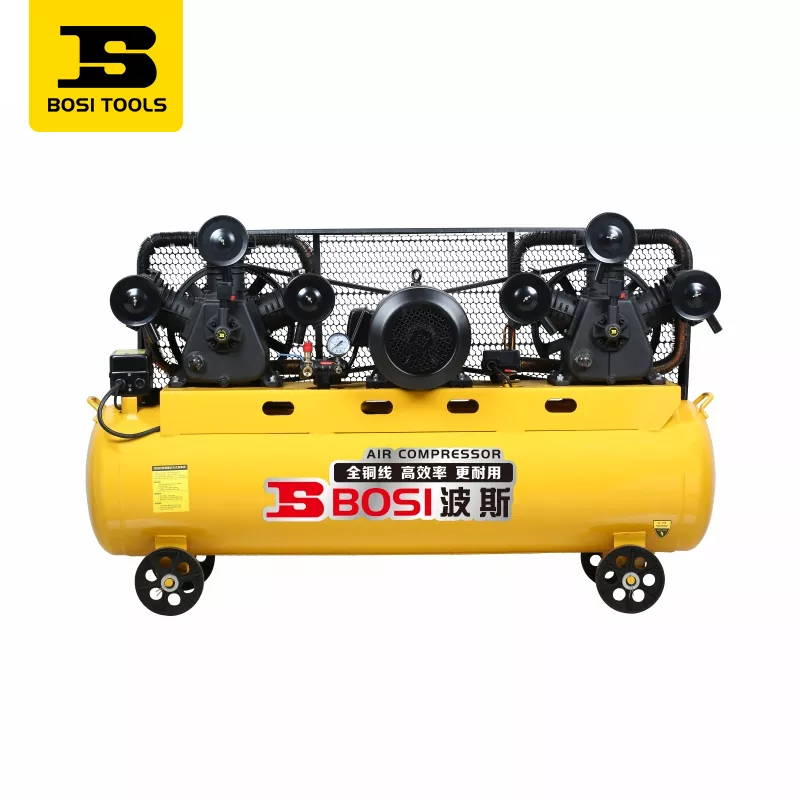
BOSI Tools, a Chinese manufacturer and supplier, offers a series of belt-driven air compressors with power ranging from 2.2-15KW, displacement from 0.25-2.0m³/min, and air tank capacity from 70-430L. They feature all-copper motors, ductile iron crankshafts, high-strength cylinders, thickened oil tanks, and standard Q235 steel air tanks. With an industrial-grade design, they are suitable for pneumatic operations such as woodworking, nailing, painting, home improvement, and pneumatic hammer installation. Inquiries and samples are welcome.
Oil-Free Silent Air Compressor
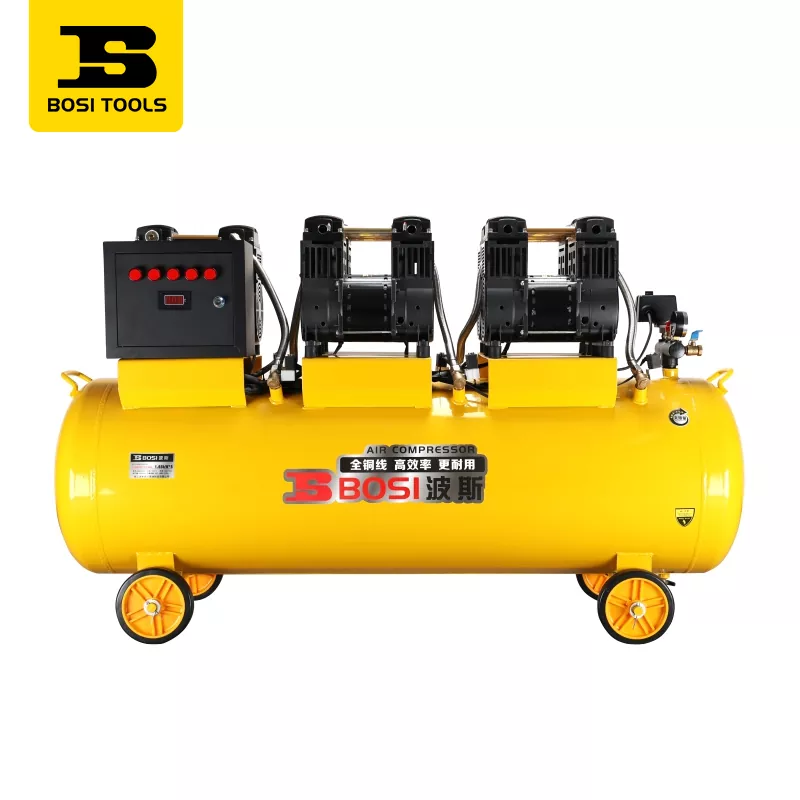
BOSI has its own factory and can manufacture a series of oil-free silent air compressors, ranging in power from 600W to multi-cylinder, large-displacement models, with air tank capacities from 9 to 300L. Featuring all-copper wire motors, our products are low-noise, energy-efficient, and environmentally friendly. Standard Q235 steel air tanks are equipped with solenoid valves for automatic unloading. Suitable for woodworking, nailing, painting, home improvement, and industrial pneumatic tools.

-
E-mail