
- English
- Español
- Português
- русский
- Français
- 日本語
- Deutsch
- tiếng Việt
- Italiano
- Nederlands
- ภาษาไทย
- Polski
- 한국어
- Svenska
- magyar
- Malay
- বাংলা ভাষার
- Dansk
- Suomi
- हिन्दी
- Pilipino
- Türkçe
- Gaeilge
- العربية
- Indonesia
- Norsk
- تمل
- český
- ελληνικά
- український
- Javanese
- فارسی
- தமிழ்
- తెలుగు
- नेपाली
- Burmese
- български
- ລາວ
- Latine
- Қазақша
- Euskal
- Azərbaycan
- Slovenský jazyk
- Македонски
- Lietuvos
- Eesti Keel
- Română
- Slovenski
- मराठी
- Srpski језик
China Reliable Electric Wrench Manufacturer
BOSI Tools is a professional electric wrench manufacturer from China, offering both Conventional Electric Wrenches and High-Power Electric Wrenches. From 300W lightweight fastening to 1050W for breaking loose rusted and seized bolts, BOSI covers a torque range from 150N·m to 1100N·m with convenient forward/reverse control, providing labor-saving and efficient bolt fastening solutions for steel structure installation, tire removal and assembly, and equipment maintenance.
For model selection or customized configurations for specific application scenarios, please contact our professional team.
What Is an Electric Wrench?
An electric wrench is a portable tool that is motor-driven and generates pulsed high torque through an impact mechanism to tighten or loosen bolts and nuts. Its core operating logic differs from the continuous rotation of an electric drill: the motor, after speed reduction via a gear set, drives an activated hammer to rotate.
When the bolt seats against the mating surface and resistance suddenly increases, the hammer, guided by a V-shaped cam slot, retracts and compresses a spring to store energy. It then disengages and surges forward, striking the driven anvil with extremely high angular momentum, delivering a brief but powerful pulsed torque.
This cycle of "hammer strike—disengagement—impact" repeats dozens of times per second; although each individual impact is short, the cumulative torque can reach hundreds or even over a thousand Newton-meters, while the operator’s wrist experiences minimal reaction force.
BOSI electric wrenches are available in six specifications from 12C to 36C. The 300W entry-level model already delivers 150N·m of torque, while the 1050W high-power model achieves a maximum torque of 1100N·m for M36 bolts. Drive sizes range from 1/2" to 1", covering bolt fastening needs from M12 to M36.
Whether for car tire changes or final tightening of high-strength bolts in steel structures, an electric wrench accomplishes the task with far less physical exertion than a manual wrench.
How to Choose the Right Electric Wrench?
|
Selection Dimension |
12C / 16C / 20C |
24C |
30C / 36C |
|
Power & Torque |
300W, Torque 150N·m / 200N·m / 250N·m |
600W, Torque 500N·m |
1050W, Torque 850N·m / 1100N·m |
|
Drive Size |
1/2" |
3/4" |
1" |
|
Applicable Bolt Range |
M12 - M20 |
M24 |
M30 - M36 |
|
Recommended Scenarios |
Car tire removal and installation, small equipment repair, batch furniture assembly, light steel structure bolt fastening |
Initial tightening of bridge steel structures, installation of tower crane standard sections, large machinery anchor bolts |
Final tightening of heavy steel structures, wind power equipment bolts, large flange connections, mining machinery repair |
When choosing, prioritize the bolt specification and required torque: for routine tasks up to M20, a 300W model is sufficient.
If M24 structural bolts are involved, the 500N·m output of the 24C is the key threshold. For M30 and larger heavy-duty high-strength bolts, the 1050W model is essential to ensure proper final tightening.
Additionally, the drive size determines the range of compatible sockets—a 1" drive can accommodate more large-size industrial sockets.
Working Principle
The impact mechanism of BOSI electric wrenches is essentially a cyclical conversion of "rotational kinetic energy → spring potential energy → pulsed kinetic energy." When the switch is pressed, the motor (ranging from 300W to 1050W) undergoes an initial stage of speed reduction and torque amplification through a planetary gear set, transmitting power to the active hammer.
During the free-spinning phase as the bolt is run down, the hammer and anvil are tightly engaged and rotate synchronously, maintaining a speed of 1900 r/min (for 300W/600W models) or 1400 r/min (for 1050W models).
Once the bolt head contacts the workpiece and resistance increases sharply, the hammer, under the action of an internal V-shaped cam slot, is forced to retract and compress a spring to store energy. After rotating through a certain angle, it disengages and surges forward, striking the anvil at an extremely high angular velocity, generating a short, high-frequency pulse of torque.
It then immediately re-engages to begin the next cycle. This process occurs dozens of times per second; the 12C cumulatively outputs 150N·m, while the 36C can exceed 1100N·m, yet the operator feels almost no recoil in their hands. During reverse operation, the hammer acts in the opposite direction, similarly utilizing pulsed impacts to efficiently break loose rusted and seized bolts.
This is the core advantage of an electric wrench over a manual wrench or standard electric drill.
Safety Precautions for Use
When operating an electric wrench, the following must be strictly observed to ensure personal safety and tool longevity:
1. Personal Protective Equipment
Wear safety goggles during operation to protect against flying bolts or metal particles. For high-torque models, the use of anti-vibration gloves is also recommended to reduce hand fatigue during prolonged operation.
2. Socket Matching
Always use impact sockets that match the bolt specification and drive size. The use of standard sockets as a substitute is strictly prohibited, as they may shatter and fly off under pulsed torque, causing injury.
3. Forward/Reverse Confirmation
Before each operation, confirm the forward/reverse switch is in the correct position; the tightening and loosening directions must not be confused. Always wait for the motor to come to a complete stop before changing direction.
4. Grip and Posture
Hold the tool with both hands to keep the body stable. Once the bolt has seated and the impact sound becomes rapid and dense, release the switch immediately to avoid damaging the threads or socket through excessive impact.
5. Power Supply and Environment
For 220V~ models, ensure proper grounding and keep away from wet environments. Keep the power cord well away from rotating parts to prevent entanglement.
6. Heat Dissipation and Maintenance
After continuous heavy-duty work, let the tool run idle for a moment to assist cooling. Regularly check carbon brush wear and keep ventilation slots clean. Pay special attention to temperature rise management for heavy-duty models like the 30C/36C.
7. Torque Staging and Verification
For critical bolt-tightening applications, it is recommended to first use a low setting for initial tightening, then use a calibrated torque wrench to verify and achieve the design value, ensuring
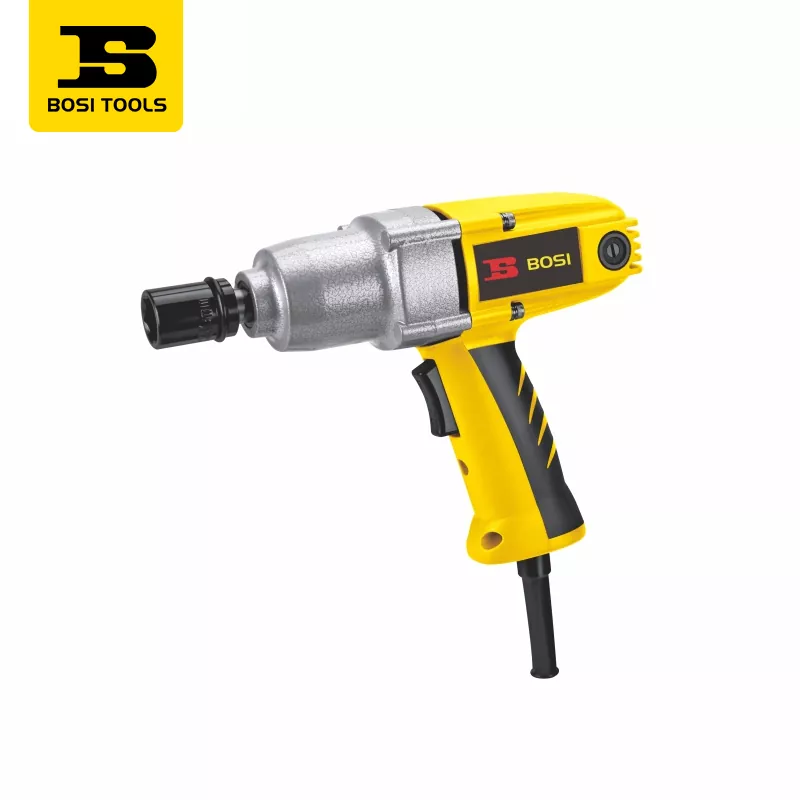
Conventional Electric Wrench
BOSI Tools is a professional manufacturer that can offer Conventional Electric Wrenches, the series covers 5 models from 12C to 36C, with maximum torque of 150-1100 N·m and maximum socket size of M12-M36. Features include 300W, 600W, and 1050W motors, forward/reverse switches, ergonomic design, and efficient heat dissipation. Suitable for automotive repair, steel structure installation, equipment disassembly and assembly, etc.

-
E-mail