
- English
- Español
- Português
- русский
- Français
- 日本語
- Deutsch
- tiếng Việt
- Italiano
- Nederlands
- ภาษาไทย
- Polski
- 한국어
- Svenska
- magyar
- Malay
- বাংলা ভাষার
- Dansk
- Suomi
- हिन्दी
- Pilipino
- Türkçe
- Gaeilge
- العربية
- Indonesia
- Norsk
- تمل
- český
- ελληνικά
- український
- Javanese
- فارسی
- தமிழ்
- తెలుగు
- नेपाली
- Burmese
- български
- ລາວ
- Latine
- Қазақша
- Euskal
- Azərbaycan
- Slovenský jazyk
- Македонски
- Lietuvos
- Eesti Keel
- Română
- Slovenski
- मराठी
- Srpski језик
How Li-ion Cordless Blower Vacuum Reflects the Shift to Battery-Powered Garden Tools
2026-10-09
The garden tool industry is undergoing a gradual transition from fuel-powered equipment to battery-driven alternatives. Improvements in lithium-ion batteries, electric motors and power management systems have expanded the practical uses of cordless equipment, particularly in routine outdoor cleaning. The Li-ion Cordless Blower Vacuum reflects this broader development, where portability, operating flexibility and reduced maintenance are becoming important considerations in garden equipment design.
Battery Technology Is Changing Outdoor Maintenance
Traditional petrol-powered blowers have long been used for clearing fallen leaves, grass clippings and light debris. However, fuel storage, engine maintenance, exhaust emissions and operating noise can complicate their use in residential areas. Corded electric equipment avoids fuel consumption but restricts movement through its dependence on a power outlet and extension cable.
Lithium-ion technology offers an alternative by combining rechargeable energy storage with portable electric operation. Modern battery systems have improved in energy density, charging performance and power delivery, helping cordless tools handle a wider range of routine maintenance tasks. According to recent industry testing, battery-powered leaf blowers have also become increasingly competitive with petrol models in selected performance categories, although results vary by equipment design and operating conditions.
This progress has changed the discussion around cordless garden tools. Instead of focusing solely on whether battery power is sufficient, users increasingly consider airflow, runtime, weight and the type of debris that needs to be removed.
Multi-Function Design Responds to Practical Needs
Another development is the integration of multiple functions into a single garden tool. A blower directs air to move leaves and loose debris into manageable piles, while a vacuum function collects suitable material for disposal or further processing, depending on the equipment's design.
The Li-ion Cordless Blower Vacuum represents this combined product category. Integrating blowing and vacuuming functions can reduce the need to switch between separate tools during routine garden maintenance. This is particularly relevant when cleaning patios, driveways, lawn edges and other outdoor spaces where debris needs to be gathered after it has been displaced.
However, combined functionality does not automatically mean that every task can be completed more efficiently. Wet leaves, compacted debris and heavier garden waste may require different airflow levels or specialised equipment. Collection capacity, attachment changes and the ease of emptying a collection bag can also influence overall productivity. Practical performance therefore depends on the relationship between tool design and the conditions in which it is used.
Runtime and Airflow Remain Key Performance Factors
Battery capacity is one of the main factors affecting operating time, but ampere-hour ratings alone do not provide a complete picture. Runtime also depends on battery voltage, motor efficiency, airflow settings, material resistance and the frequency of high-power operation.
Higher output can help move dense or damp leaves, yet it usually increases energy consumption. Lower settings may be sufficient for dry leaves on paving or light debris around garden furniture. Variable-speed control, where available, allows users to adjust output according to the task rather than operating continuously at maximum power.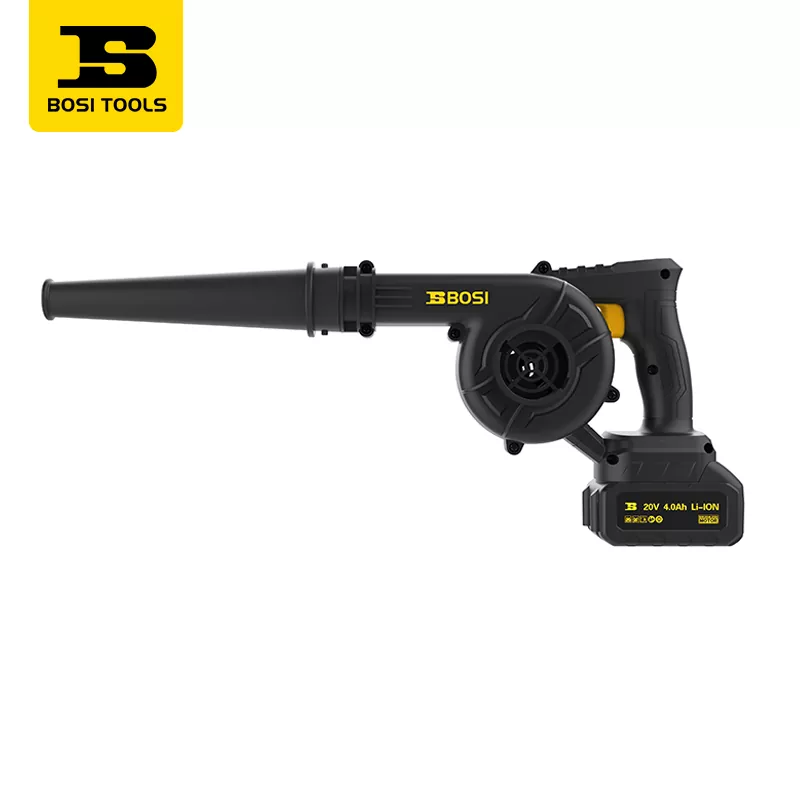
For a Li-ion Cordless Blower Vacuum, evaluating performance requires attention to both blowing and collection modes. Air volume and air speed help describe blowing capability, while vacuum intake, debris handling and collection design affect the second function. These measurements should be considered alongside battery runtime and tool weight instead of being interpreted independently.
Battery compatibility is another practical consideration. Where a product belongs to a wider cordless tool platform, shared batteries and chargers may simplify equipment management. Compatibility should nevertheless be confirmed for the specific battery series, voltage and model rather than assumed across products from the same brand.
Noise, Maintenance and Environmental Considerations
Battery-powered tools eliminate exhaust emissions at the point of use and generally require less routine maintenance than petrol engines. They do not need engine oil changes, spark plug replacement or carburettor servicing. These differences can simplify upkeep for households and maintenance teams handling frequent, short-duration cleaning tasks.
Noise reduction is also an important factor in the shift toward electric outdoor equipment. Battery-powered models can operate more quietly than comparable petrol tools, although the actual sound level varies with motor speed, fan design and airflow. Electric operation does not mean silent operation, and hearing protection may still be appropriate for some equipment and working conditions.
Environmental performance requires a broader assessment. Battery tools reduce direct exhaust emissions during operation, but electricity generation, battery production, charging and end-of-life recycling also contribute to their overall environmental footprint. Battery longevity, repairability and responsible recycling therefore remain relevant to the long-term sustainability of cordless garden equipment.
What the Transition Means for Garden Tool Development
The movement toward battery-powered equipment is not simply a change in energy source. It is influencing product design, maintenance routines, accessory systems and expectations for everyday usability. Manufacturers are increasingly balancing motor output with energy efficiency, ergonomic handling and compatibility across tool platforms.
BOSI Tools operates across hand tools, electric tools, pneumatic tools and garden equipment, with an established focus on product development and integrated manufacturing. Its broader investment in lithium-powered electric tools reflects the wider industry interest in extending battery technology across different applications. Specific performance characteristics, however, need to be assessed against the specifications and test results of each individual model.
Ultimately, the development of the Li-ion Cordless Blower Vacuum illustrates how garden equipment is adapting to demands for mobility, multifunctionality and simpler operation. Continued advances in batteries and motor control may further expand the role of cordless tools, while runtime, airflow, noise, handling and recycling will remain important factors in determining their suitability for different outdoor maintenance tasks.
Related News
- What Are Steel Stranded Cable Cutters and How Do They Work?
- How Do D-Type Bolt Cutters Deliver Clean, Reliable Cuts?
- How Does a High-end Hacksaw Frame Improve Cutting Performance and Professional Results?
- What Makes Carbon Steel Forging Wire Clamp Reliable for Modern Industrial Applications?
- Why Are European Style Pointed Nose Pliers Essential for Precision Hand Tool Applications?
- How Does a Quick Adjustment Water Pump Clamp Improve Installation Efficiency and Reliability?

-
E-mail