
- English
- Español
- Português
- русский
- Français
- 日本語
- Deutsch
- tiếng Việt
- Italiano
- Nederlands
- ภาษาไทย
- Polski
- 한국어
- Svenska
- magyar
- Malay
- বাংলা ভাষার
- Dansk
- Suomi
- हिन्दी
- Pilipino
- Türkçe
- Gaeilge
- العربية
- Indonesia
- Norsk
- تمل
- český
- ελληνικά
- український
- Javanese
- فارسی
- தமிழ்
- తెలుగు
- नेपाली
- Burmese
- български
- ລາວ
- Latine
- Қазақша
- Euskal
- Azərbaycan
- Slovenský jazyk
- Македонски
- Lietuvos
- Eesti Keel
- Română
- Slovenski
- मराठी
- Srpski језик
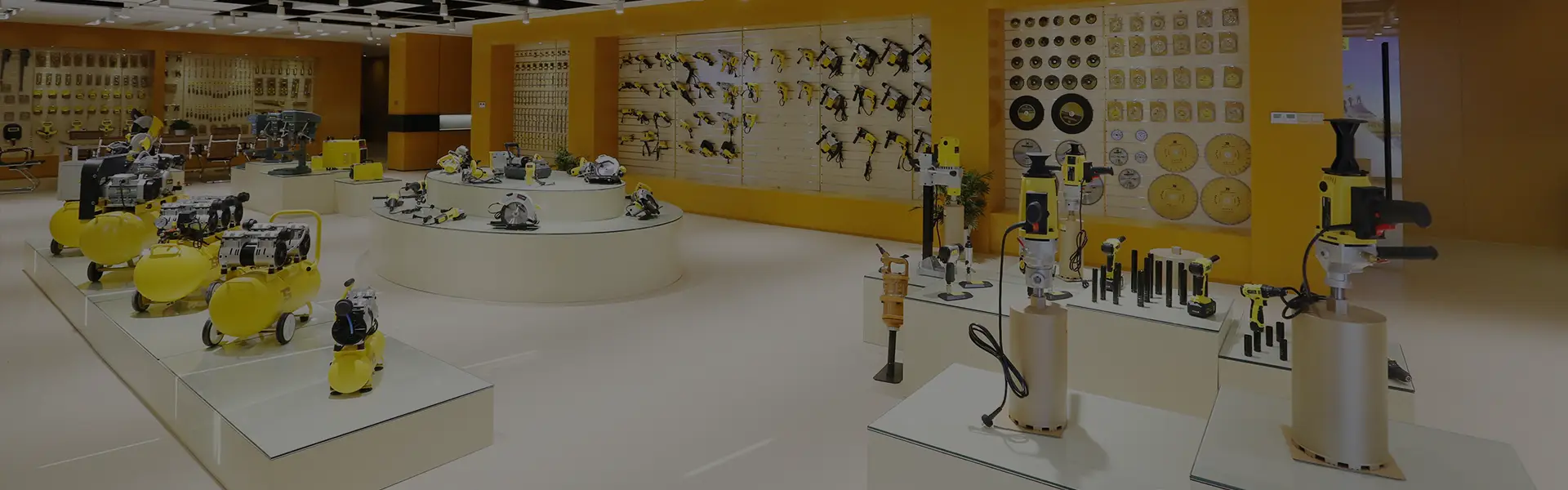
Cordless Impact Wrench Buying Guide: Torque, Drive Size, and Battery Selection
2026-11-04
Choose a cordless impact wrench by the joints it must service, then match its torque evidence, square drive, socket, battery, and working envelope. A maximum-torque number helps shortlist tools. It does not establish how reliably a wrench will remove your fasteners or how accurately it will tighten them.
For importers, distributors, and maintenance buyers, the purchase is a complete working configuration. A higher-rated machine can be poor value if its socket cannot reach the joint, its battery obstructs access, or the supplied kit creates charging delays. This guide connects those decisions to published BOSI configurations and a practical method for comparing samples.
What is a cordless impact wrench?
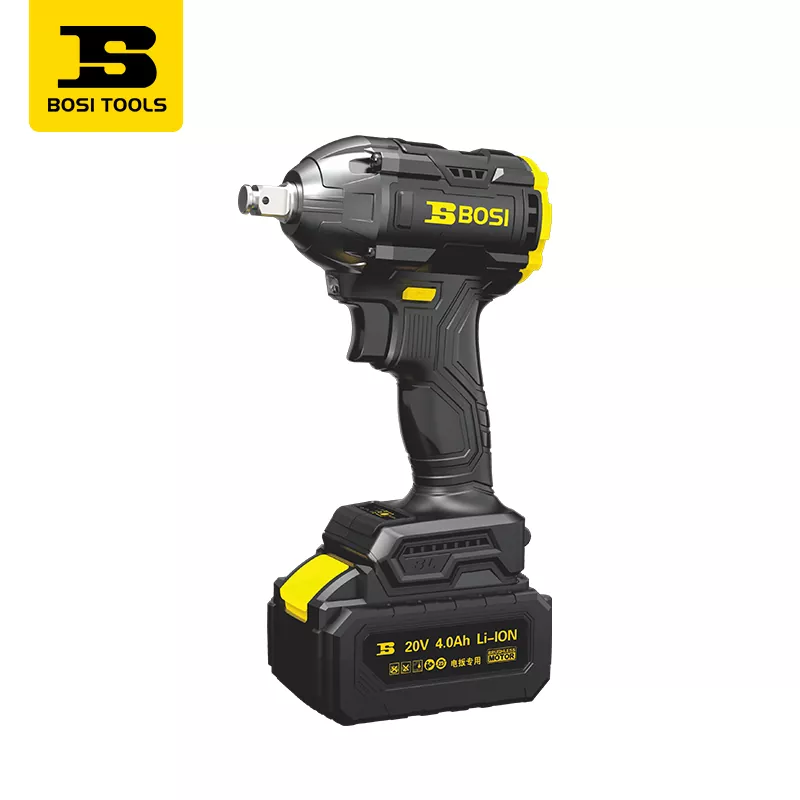
A cordless impact wrench is a battery-powered fastening tool that delivers repeated rotational blows through an output anvil. Its motor drives a hammer mechanism; the mechanism transfers pulses to the anvil and attached socket. These pulses help turn resistant nuts and bolts. “Cordless impact gun” is a common informal name for the same tool category.
Impact wrench vs. impact driver, ratchet, and torque wrench
The output interface is a useful first distinction. An impact wrench commonly uses a square drive for sockets. An impact driver commonly holds 1/4-inch hex accessories for driving screws and other approved tasks. A cordless ratchet serves a different access and rundown role. A torque wrench measures or controls tightening according to its design and instructions.
These tools can appear in the same maintenance process, but their names are not interchangeable. A purchasing request for an “impact tool” should identify the interface and task. For drilling and screwdriving requirements, use the separate cordless drill buying guide.
How the connection works
Battery → motorHammer mechanism → anvilImpact-rated socket → fastener
TOOL CONNECTION
The square-drive size describes the anvil-to-socket connection.
FASTENER CONNECTION
The socket's working opening must match the nut or bolt head.
JOINT REQUIREMENT
Thread size, joint condition, and the approved fastening process determine the job.
Match the tool to automotive and maintenance tasks
Start with a list of joints, not a vehicle label or the largest torque rating in a catalogue. “Automotive repair” can mean accessible wheel fasteners, recessed suspension joints, or restricted engine-bay work. Those tasks place different demands on the same battery impact wrench.
| Application | Define the actual task | Main selection check |
|---|---|---|
| Wheel and tire service | Vehicle-specific wheel fasteners; removal, rundown, or permitted installation work | Removal reliability, socket clearance, control, and the required final-tightening process |
| Suspension and equipment brackets | Joint condition, fastener access, thread and head size | Complete tool-and-socket envelope; a larger body may not reach the joint |
| Machinery maintenance | Repeated joints, restricted positions, and expected resistance | Performance across the work cycle, approved accessories, and handling |
| Mixed distributor assortment | Distinct customer job families rather than one universal tool | Clear configuration differences, compatible kit contents, and service requirements |
Separate removal from installation in the enquiry. Removal requires enough capability to release the target joint within the permitted operating procedure. Installation requires control of the specified assembly process. A wrench can perform well in one role and still need a separate tool or verification step for the other.
For a mixed maintenance fleet, a useful starting point is to standardize around repeatable joint families. Select a configuration for routine accessible work, then evaluate a second configuration for higher removal demand or restricted access. Buying the highest-rated tool for every station can add bulk without improving the work that station actually performs.
A concise task record should state the equipment, joint, socket, access restriction, removal condition, and acceptance criterion. That record is more useful to a supplier than “recommend your best impact wrench.”
How much torque do you need? Fastening vs. breakaway ratings
There is no single torque requirement for every car, lug nut, or industrial fastener. Establish the joint and operation first, then compare ratings with the same meaning and supporting conditions. Even two figures expressed in N·m may describe different tests.
| Term | What it describes | What to request |
|---|---|---|
| Specified installation torque | A requirement for a particular assembly and procedure | The vehicle or equipment manufacturer's applicable instructions, including joint preparation |
| Fastening torque rating | Reported tightening performance under a stated method | Joint or fixture, battery, mode, application time, and measurement method |
| Breakaway or removal rating | Reported ability to release a prepared joint under stated conditions | Joint preparation, dwell, removal endpoint, time limit, and repeat results |
| Maximum torque | A published upper rating whose meaning depends on the supplier's definition | Direction, test method, and whether it represents fastening, removal, or another measurement |
Installation torque does not predict removal torque
Static friction, corrosion, and changes in the joint can make removal torque differ from the original installation torque. NASA's Mechanical Fastener Torque Guidelines, section 2.5.2, explain why backing-off torque does not indicate installation torque. The document addresses spacecraft and critical ground-support equipment; its torque tables are not automotive service specifications.
A wheel fastener's prescribed installation value therefore cannot, by itself, prove that a wrench will remove it after service exposure. Nor does a high breakaway rating establish accurate installation at a much lower specified value.
Use high-torque ratings to shortlist, then verify the task
Ask whether a quoted figure was obtained with the battery and socket you intend to buy. A result using a different pack or a long application time may not represent your configuration or work cycle. Keep unsuccessful attempts in the comparison; reporting only the joints that released can hide a capability problem.
Avoid assigning “working torque” as a fixed percentage of maximum torque. Such a shortcut conceals the joint, operating time, and measurement conditions. Select the lowest-burden configuration that reliably completes the defined task, with the control and access the application needs.
Impact wrench sizes: 3/8 vs. 1/2 vs. 3/4-inch drive
Impact wrench size usually refers to the square drive. It does not state the socket opening, bolt diameter, or guaranteed torque. A 1/2-inch drive connects to a socket with a matching drive recess; the socket's other end is selected for the fastener head.
| Square drive | Reason to consider it | Check before ordering |
|---|---|---|
| 3/8 inch | A candidate when available socket combinations and tool packaging suit access-sensitive work | Actual output, socket strength and availability, head dimensions, and joint suitability |
| 1/2 inch | A candidate for automotive and general maintenance socket inventories | Required removal performance; this drive size includes tools with substantially different ratings |
| 3/4 inch | A candidate when the selected tool and socket system suit higher-demand maintenance work | Complete weight, working clearance, retention, and approved operating limits |
| 1 inch | A separate market category to evaluate for applicable large-equipment tasks | The actual tool specification and handling arrangement; availability is not implied by smaller-drive product ranges |
What size impact wrench do you need for lug nuts?
A 1/2-inch square-drive tool is a sensible category to evaluate for passenger-vehicle wheel service when the required impact socket and clearance suit it. It is not a guarantee for every wheel fastener. Compare removal performance on representative joints and retain the vehicle-specific installation procedure.
BOSI's published range illustrates the distinction: its 350, 550, and 850 N·m maximum-torque configurations all have a 1/2-inch drive. Drive size alone cannot choose among them. A seized joint should prompt assessment under the approved service procedure, not an assumption that a larger drive automatically solves it.
A 1/4-inch hex interface is not a 1/4-inch square drive
The BOSI Li-ion Brushless Dual-Purpose Wrench lists a 1/2-inch square output plus a 1/4-inch hex interface. That is an accessory-interface description. Check the approved accessory, retention, and operating mode for each intended use; the extra interface does not establish precision torque control.
Battery impact wrench kits: capacity, output, and compatibility
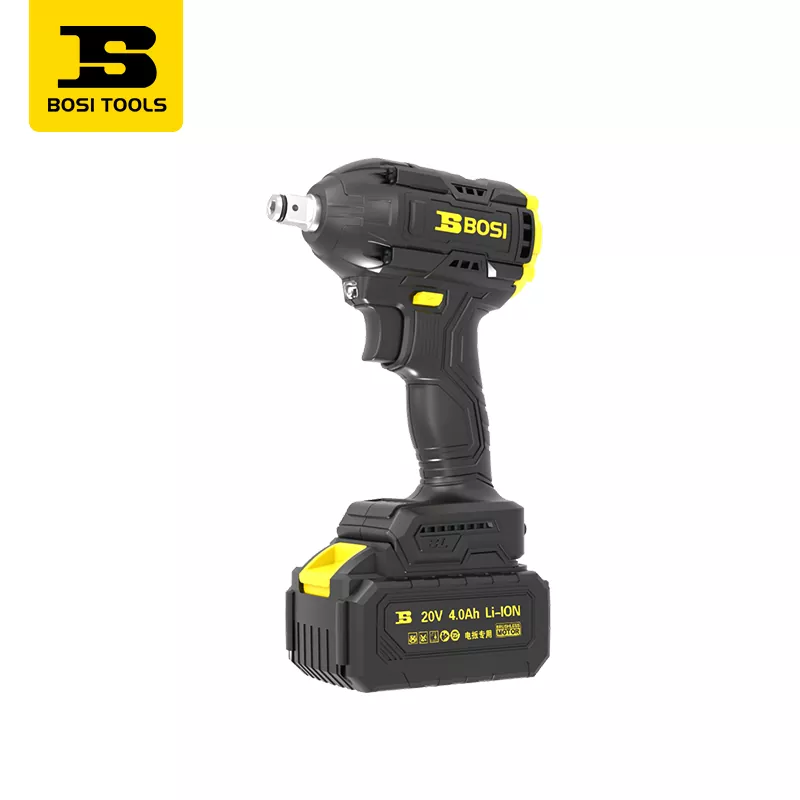
Specify the exact battery with the tool. Ampere-hours describe rated charge capacity; they do not directly specify the current a pack can supply, the torque at the socket, or completed removals per charge. Pack construction, protection limits, temperature, state of charge, and the task affect the result.
What does 4.0 Ah vs. 6.0 Ah tell you?
The capacity ratio is 6.0 ÷ 4.0 = 1.5. It is not evidence of 1.5 times the runtime, torque, or service life. In the BOSI range, the published 350 N·m configuration pairs with 20 V/4.0 Ah, while the 850 N·m configuration pairs with 20 V/6.0 Ah. Both tool and pack differ, so a performance difference between those configurations cannot be assigned to battery capacity alone.
If you want to isolate the battery's effect, compare packs approved for the same machine while controlling the other conditions. If you want to choose a kit, compare each complete kit as supplied. These are different purchasing questions.
Bare tool vs. complete cordless impact wrench kit
A bare tool makes sense when verified compatible batteries and chargers are already available. A complete kit can simplify deployment, but “with battery” is not a complete packing specification. Record pack model, capacity, quantity, charger model and input, tool configuration, and the included accessories or case.
BOSI's wrench descriptions list two batteries and one charger as the standard configuration. Confirm the contents against the actual quotation and packing list. Two packs do not, by themselves, establish uninterrupted shift operation: compare the working interval, charging time, cooling requirements, and access to power.
Shared voltage labels do not prove interchangeability. Confirm the exact supported battery and charger combination, including electrical and mechanical compatibility. For a wider purchasing plan, use the cordless power tools selection guide to connect the wrench purchase to the rest of the workshop's equipment.
Key features: RPM, IPM, and control modes
No-load RPM measures rotational speed without the working load. IPM describes impacts per minute. Neither is a substitute for measured performance on the target joint, and RPM cannot be converted into IPM without information about the mechanism and operating conditions.
The BOSI wrench table lists no-load speed. Its published upper speed endpoints include 2,600 rpm for the 350 N·m configuration and 2,200 rpm for the 850 N·m configuration. The higher maximum-torque label accompanies a lower no-load speed in this comparison. Ranking these tools by RPM would therefore answer the wrong question.
Assist modes manage behavior; verify the endpoint
Speed selection, trigger response, and loosening-assist behavior can affect handling. An automatic stop or slowdown is useful only when its behavior suits the work. Ask what triggers the function and observe it on the selected sample: fastener release, continued rundown, a time condition, or another control input may produce different results.
A numbered setting is not automatically a calibrated N·m setting. Unless a defined accuracy claim and applicable verification support it, treat a control mode as an operating function. Final tightening still follows the specified assembly procedure.
For procurement, record the mode used with each result. A trial in maximum mode cannot establish the behavior of a lower mode, and a demonstration of a clean, lightly seated nut does not characterize a corroded maintenance joint.
Choosing a compact impact wrench for tight spaces
Evaluate clearance with the socket and battery installed. A short tool head can still be unusable if a deep socket adds too much length or the pack hits an adjacent housing. An extension may change reach, but it also changes the assembly being evaluated. Use only approved attachments and compare the arrangement the technician will actually hold.
Check the complete working envelope
AXIAL CLEARANCE
Tool head + socket + any permitted extension must reach and engage the fastener.
SIDE CLEARANCE
The housing, grip, and operator's hand need room to position and control the tool.
BATTERY CLEARANCE
Check the fitted pack against nearby parts and the route for placing or withdrawing the tool.
For an impact wrench for tight spaces, request head length, height with the selected pack, and working weight with that pack. A catalogue's bare-tool weight excludes part of what the operator carries. Compare reach and balance in the intended position as well as the ability to remove a fastener.
Socket retention also matters. Check the specified retention system, engagement, and accessory-change procedure. A setup that needs frequent socket changes may have different handling priorities from a station repeating one joint all day.
BOSI 1/2 and 3/4-inch impact wrench configurations compared
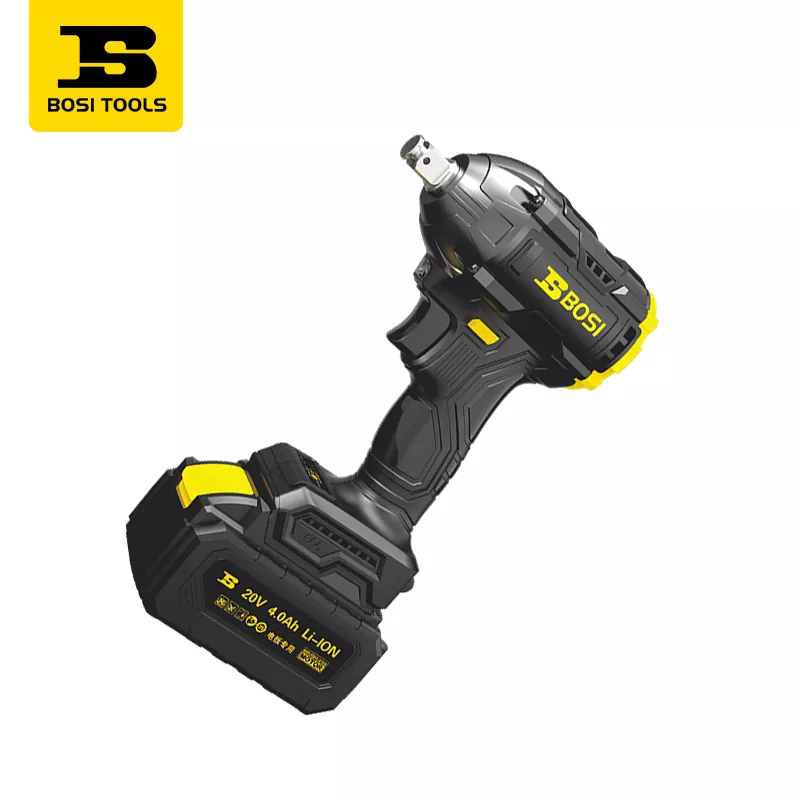
The BOSI Li-ion Brushless Wrench product table publishes four torque and battery combinations. The table below preserves the source's “Maximum Torque” label. It does not relabel those figures as fastening accuracy or independently measured breakaway capability.
| Maximum torque | Battery configuration | Square drive | Useful comparison question |
|---|---|---|---|
| 350 N·m | 20 V / 4.0 Ah | 1/2 inch | Does this configuration complete the routine target joints within the agreed trial conditions? |
| 550 N·m | 20 V / 4.0 Ah | 1/2 inch | What measurable task benefit does the higher rating provide with the specified pack? |
| 850 N·m | 20 V / 6.0 Ah | 1/2 inch | Does the complete configuration improve removal reliability or cycle time enough to justify its cost and handling? |
| 1,200 N·m | 20 V / 6.0 Ah | 3/4 inch | Do its socket system, access, and task results suit the higher-demand application? |
Three configurations share a 1/2-inch drive while their published maximum ratings differ. That is a practical reason to keep interface selection separate from performance selection. Likewise, the 850 and 1,200 N·m configurations share a published battery capacity; the pack label cannot explain their complete performance difference.
Where the dual-purpose configuration fits
BOSI separately lists a dual-purpose wrench at 20 V/4.0 Ah and 350 N·m maximum torque, with the square and hex interfaces described above. Include it in a comparison when the approved accessory functions match the buyer's work. Compare the actual configuration rather than assuming that an added interface makes it equivalent to every dedicated drill, driver, or torque-controlled tool.
For a distributor assortment, position these choices by verified customer tasks and kit contents. Keep supplier maximum ratings on the specification sheet, and keep your application acceptance results alongside them. Customers should be able to distinguish a catalogue specification from an observed result on a defined joint.
How to compare impact wrench samples and performance claims
A useful factory sample review starts with a repeatable joint and a written endpoint. An impressive single removal offers little purchasing guidance if the joint preparation, pack condition, and application time are unknown. Define the comparison before seeing which sample performs best.
Build a record that another technician can repeat
| Record | Details to hold consistent or document | Why it matters |
|---|---|---|
| Joint and preparation | Fastener dimensions and grade, mating parts, lubrication condition, preparation method, and dwell | Changing the joint changes the comparison |
| Tool and power supply | Sample identity, battery model, condition, starting charge, temperature, and selected mode | The result belongs to a configuration, not a motor label alone |
| Attachment | Impact socket, retention, and any approved extension or adapter | The tested attachment path should represent the purchased setup |
| Operation and endpoint | Direction, permitted application time, release or fastening criterion, and measurement method | Removal, rundown, and final tightening answer different questions |
| Repeated results | Number attempted, number completed, individual times, unsuccessful attempts, and interruptions | An average of successful attempts alone conceals failures |
For removal screening, prepare equivalent joints and define successful release and the allowed attempt duration within the operating instructions. Record attempts that do not release. Do not silently extend the allowed time for one sample or replace its battery halfway through a comparison without recording the change.
For fastening evaluation, specify the intended assembly process and an appropriate measurement method. A loosening test cannot validate final tightening accuracy. Similarly, an inertia-based tester result and a test on an assembled joint are different measurements; keep their labels and conditions distinct.
Separate controlled comparison from field relevance
Controlled joints help compare configurations. Representative service joints help establish whether the shortlist suits the work. Use both where practical. Random corroded fasteners are poor matched test specimens, while identical clean fixtures cannot reproduce every service condition.
If a lower-capability sample fails to release the defined joints, record the failure instead of describing the tool only as “slower.” If two samples both pass, compare time, handling, charging interruptions, and the condition of the joint after the permitted operation. A faster attempt is useful only when the result is acceptable.
Check a cited standard's scope
ISO 5393:2017 covers performance testing for tools applying torque in a generally continuous manner. Its public scope explicitly excludes impact and impulse wrenches. A generic reference to that standard therefore does not validate an impact wrench's torque claim. Ask for the method actually used, its applicability, the equipment, and the reported results.
Agree on acceptance criteria before placing the order, then identify the approved sample, battery, accessories, and packing specification. This gives production inspection a defined reference rather than a broad promise such as “professional performance.”
Sockets, final tightening, and verification
Select sockets expressly intended for impact operation, with the correct drive, working size, retention, and permitted application. Appearance or an alloy name alone does not establish suitability. Inspect and use the socket according to its instructions, and follow the tool's protective-equipment and operating requirements.
The public scope of ISO 2725-2:2017 addresses dimensions, designation, and marking for machine-operated impact square-drive sockets. ISO 1711-2:2019 addresses hardness and minimum torsional strength for machine-operated square-drive sockets. These scopes help buyers ask specific questions; citing them here does not certify a particular BOSI product or accessory.
Keep the final-tightening process intact
For wheel installation or another specified assembly, follow the applicable vehicle or equipment manufacturer's procedure. Use the prescribed final-tightening and verification method with an appropriate verified tool. An impact wrench's maximum rating, speed mode, or automatic-stop function does not independently establish that the required installation torque has been achieved.
Include the checking tool and its required control in the purchasing plan when the process needs them. A workshop does not have a complete fastening system merely because it owns a powerful removal tool.
For a joint requiring an engineered torque-angle or other controlled procedure, preserve that procedure. Do not replace it with a universal impact duration or a fixed fraction of the final torque. Joint preparation and permitted tool use remain part of the equipment-specific instructions.
What makes an impact wrench good value for bulk buyers?
Good value means an acceptable cost for the work the complete configuration performs. Compare the tool, specified packs, charger, required sockets, charging arrangements, and service provisions. Add the labor consequences of slow or unsuccessful attempts. A lower invoice price can lose its advantage if the kit repeatedly needs a second tool to finish routine jobs.
A transparent break-even example
Consider an illustrative upgrade with a US$30 premium and labor valued at US$20 per hour. Suppose controlled comparisons establish a four-second saving per completed removal, with equal acceptable results and other operating costs unchanged. These are hypothetical purchasing inputs, not BOSI prices or measured performance claims.
Illustrative labor-only break-even
SAVING PER REMOVAL
4 ÷ 3,600 × US$20
≈ US$0.0222
RECOVER THE PREMIUM
US$30 ÷ (4 ÷ 3,600 × US$20)
= 1,350 removals
DECISION CONDITION
The measured saving must persist across acceptable work; include other cost differences separately.
The result changes directly with the inputs. If no time saving is demonstrated, this labor-saving argument does not recover the premium. If the main benefit is fewer failed removals, evaluate those avoided costs separately rather than burying them in an optimistic average.
A service-life improvement requires endurance evidence under defined loads and work cycles. Neither a larger Ah value nor a brushless motor label establishes a specific lifetime multiple. Request evidence that matches the claim you intend to make to your own customers.
Turn sample approval into a clear order
Record the approved tool configuration, drive, packs and charger, accessories, labels, and packing contents. Ask what spare parts, technical documents, and service arrangements are available for that exact configuration. For an export order, identify the destination market and request the applicable documentation without assuming that a document for another model covers the purchase.
A useful assortment may combine a routine-work configuration with a higher-demand or access-focused option. Let task acceptance and customer needs justify those choices. “Best cordless impact wrench” is a purchasing conclusion that depends on those conditions, not a universal award attached to the highest maximum rating.
Ningbo Shiji Bosi Tools Co., Ltd. publishes the configurations used in this guide. For a matching enquiry, send the target joints, removal and installation requirements, socket sizes, access limits, duty pattern, destination market, and required kit contents through BOSI's contact page or bosi01@bosi.cn. Ask for the current configuration sheet and the test conditions behind the torque figure being compared.
Frequently asked questions
Can one 1/2-inch impact wrench cover every lug-nut job?
No. The 1/2-inch dimension describes the drive connection. Suitability also depends on the tool configuration, socket clearance, joint condition, and required operation. Establish removal capability on representative joints and follow the vehicle-specific installation procedure.
Can I compare one supplier's maximum torque with another's breakaway torque?
Only if their definitions and test conditions support that comparison. Request the operating direction, joint or fixture, battery, socket, mode, application time, and endpoint. Otherwise, retain the separate labels and compare samples on a common task.
Should I choose a 6.0 Ah battery instead of 4.0 Ah?
Choose an approved pack that meets the task and work cycle. A 6.0 Ah rating is 1.5 times a 4.0 Ah rating in charge capacity, but it does not establish the same increase in runtime or torque. Compare the complete configuration and check handling and charging needs.
Does an automatic-stop mode replace a torque wrench?
An automatic-stop function alone does not establish calibrated tightening accuracy. Follow the specified assembly procedure and use the appropriate final-tightening and verification method. Evaluate the stop mode's actual behavior separately from the required installation torque.
What should a cordless impact wrench kit quotation include?
Specify the tool configuration and drive, exact battery model and capacity, pack quantity, charger model and input, and included accessories or case. Identify any required impact sockets separately and confirm the quoted contents against the packing list.
What should an importer keep after approving a sample?
Keep the sample identity, complete configuration, agreed test method and results, acceptance criteria, and order specification. Retain the relevant technical and destination-market documents, and define how later production changes will be reviewed against the approved configuration.
Related News
- Angle Grinder Buying Guide: How to Choose Size, Power, Speed, and Discs
- Brushless vs. Brushed Drills: Differences, Performance, and Cost
- Drill Bit Types and Uses: How to Choose for Wood, Metal, and Concrete
- Hammer Drill vs. Rotary Hammer: Which Do You Need for Concrete?
- Cordless Drill Buying Guide: How to Choose the Right Drill and Kit
- How to Choose Cordless Power Tools: Specs, Batteries, and Tool Systems


-
E-mail