
- English
- Español
- Português
- русский
- Français
- 日本語
- Deutsch
- tiếng Việt
- Italiano
- Nederlands
- ภาษาไทย
- Polski
- 한국어
- Svenska
- magyar
- Malay
- বাংলা ভাষার
- Dansk
- Suomi
- हिन्दी
- Pilipino
- Türkçe
- Gaeilge
- العربية
- Indonesia
- Norsk
- تمل
- český
- ελληνικά
- український
- Javanese
- فارسی
- தமிழ்
- తెలుగు
- नेपाली
- Burmese
- български
- ລາວ
- Latine
- Қазақша
- Euskal
- Azərbaycan
- Slovenský jazyk
- Македонски
- Lietuvos
- Eesti Keel
- Română
- Slovenski
- मराठी
- Srpski језик
Angle Grinder Buying Guide: How to Choose Size, Power, Speed, and Discs
2026-11-04
Choose an angle grinder by matching the material, operation, approved disc, and working space first. Then compare power supply, loaded performance, handling, and operating cost. Disc diameter sets a size class; wattage and no-load RPM alone cannot tell you how much acceptable work the tool will complete.
For importers, distributors, and workshop buyers, the useful comparison includes the complete configuration: machine, guard, attachment, mounting hardware, and power supply. This guide connects those choices to published BOSI specifications and a practical sample-evaluation method.
What is an angle grinder, and how does it work?
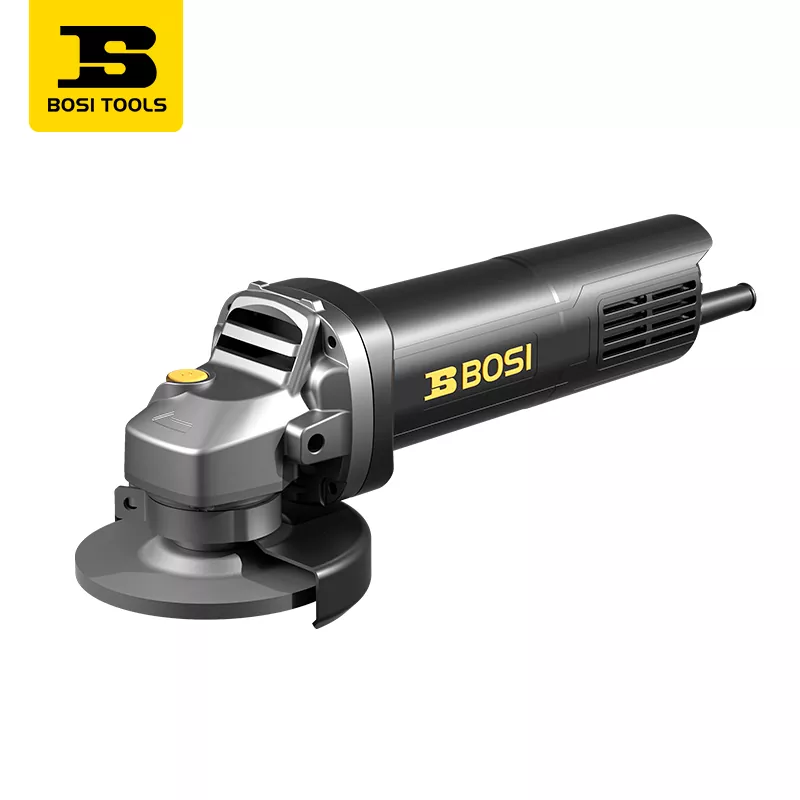
An angle grinder is a handheld power tool that drives a disc through an angled gearbox. With the appropriate approved attachment, it can cut, grind, deburr, or prepare a surface. It is also called a side grinder. “Portable grinder” and “handheld grinder” are broader descriptions that can include other tool arrangements.
The motor drives the gearbox, which changes the direction of rotation and drives the output spindle. The attachment mounts at that spindle. The attachment and machine together determine the permitted operation; a disc that physically fits is not automatically suitable.

Parts of an angle grinder and their functions
From power supply to working attachment
Supply → motorAngled gearbox → spindleApproved attachment
MOUNTING
The specified flanges, nut, or approved mounting system locate and retain the attachment.
GUARDING
The guard must suit the machine and the permitted attachment and operation.
CONTROL
Main grip, side handle, and switch layout affect how the complete tool is controlled.
The spindle lock assists accessory changes when used as instructed with the power isolated. It is separate from an operating brake. Likewise, a compact body does not remove the need for the specified handles or proper control.
Angle grinder vs. other grinder types
A bench grinder supports its wheels on a stationary machine; a die grinder typically places its accessory in line with the tool body. Those layouts serve different access and workholding needs. When requesting a quotation, specify an angle grinder and its required operation rather than asking only for a “grinder.”
What is an angle grinder used for?
The main uses for an angle grinder are cutting, material removal, and surface preparation. Start with the required result. Cutting a tube to length, dressing a weld, and removing rust may involve the same tool body, but they require different attachments and acceptance checks.
| Task | Attachment category to assess | Machine and setup checks | Acceptable result |
|---|---|---|---|
| Cutting steel tube or section | Cutting disc approved for the material. | Reach, mounting, cutting guard, speed rating, and workpiece support. | Completed cut meeting the specified position and edge condition. |
| Weld grinding or deburring | Suitable grinding wheel or flap disc. | Access, load behavior, permitted contact method, and handling. | Required material removal without unacceptable damage to the part. |
| Rust or coating removal | Approved cleaning attachment, such as a suitable wire brush or stripping disc. | Attachment speed, guard requirements, and surface compatibility. | Specified surface preparation without excessive base-material removal. |
| Tile, stone, or masonry work | Material-specific diamond attachment approved for the operation. | Tool suitability, depth, guarding, and an appropriate dust-control system. | Required geometry and finish with the specified exposure controls. |
Choosing an angle grinder for cutting metal
Identify the metal and section geometry, not just its nominal thickness. A tube, flat plate, and solid bar present different access and support conditions. Establish the required cut before deciding whether the tool and disc can reach it.
For repeated carbon-steel cutting, I would compare the approved disc and workholding arrangement before increasing the machine's power rating. If the disc is unsuitable or the work closes onto it, more power does not correct the setup. Do not use side pressure on an attachment intended only for cutting.
Grinding, cleaning, and finishing need separate choices
Grinding removes material; finishing controls the remaining surface. The fastest removal rate may leave more finishing work. A useful sample trial therefore checks both the initial operation and any work needed afterward.
For construction tasks involving stone or concrete, choose the complete dust-control arrangement with the grinder. A suitable blade alone does not establish that the machine, guard, and extraction equipment are appropriate.
Angle grinder sizes: choose diameter for reach and handling
Angle grinder size usually refers to the nominal diameter of its intended wheel or disc. Common market classes include 100, 115, 125, 150, 180, and 230 mm. These describe different machines; they are not a list of discs that can be fitted to one grinder.
| Nominal disc class | Selection emphasis | What still needs confirmation |
|---|---|---|
| 100 / 115 / 125 mm | Access, handling, and the reach needed for smaller work. | Actual cutting capacity, approved accessories, grip, and local consumable supply. |
| 150 mm | Additional reach with a different tool and attachment package. | Weight, mounting, speed, and suitability for the intended operation. |
| 180 / 230 mm | Larger attachments and work requiring their reach. | Rated capacity, operating space, support, power supply, and operator control. |
Disc diameter does not specify exact cutting depth
The full disc radius is not available as cutting depth. Flanges, the gear head, guard, approach angle, and disc wear affect usable reach. Use the manufacturer's cutting-capacity information for the specified setup, then confirm access on the workpiece.
A larger outside diameter also does not prove that a tool will remove material faster. The attachment, load, and tool design remain part of that comparison. Buy the reach required by the job rather than the largest size available.
Standardize only where the work permits it
For a distributor or workshop fleet, fewer compatible disc sizes can simplify stocking. Check customer tasks and local availability before standardizing. Keeping one large tool for exceptional work may be more practical than supplying every operator with a larger machine.
Angle grinder wattage: input power and loaded performance
A power rating helps describe a tool, but it is not a measurement of the finished work. Establish whether the specification describes electrical input, mechanical output, or a short-term condition. Those values cannot be substituted for one another.
Compare ratings in the same context
BOSI lists the S1M-08-100A at 750 W and the S1M-BS11-100A at 1200 W, both with a 100 mm wheel and 11,000 r/min no-load speed. The listed power ratio is 1200/750 = 1.6. That does not establish 1.6 times the cutting speed, torque, or service life. The published figures are on the Black Warrior product page.
For an AC tool, a current rating also needs its supply-voltage context. Multiplying volts by amps gives apparent input power; it does not establish mechanical output. Losses and the electrical operating conditions must be accounted for before drawing an output-power conclusion.
Separate overload figures from normal operation
The BOSI Angle Grinding Machine page describes a 3800 W overload figure as a short-term peak. That peak does not establish the continuous rating of the large models. Select from the actual nameplate and operating instructions, then evaluate the intended work cycle.
Look for useful output under load
An undersized grinder can lose working speed under excessive load. Forcing the feed can increase heating and binding risk rather than solve the mismatch. Compare completed acceptable cuts, required pauses, and disc consumption under the same conditions. A high number on the box cannot replace that record.
Angle grinder RPM: no-load speed, rim speed, and variable speed
RPM describes revolutions per minute. No-load RPM is the speed without the working cut or grinding load. It helps identify an operating condition and assess attachment compatibility; it does not specify material-removal rate.
Read speed together with diameter
The calculated speed at a disc's outer edge is v = π × D × n / 60, where D is diameter in meters and n is r/min. A larger disc can have a faster-moving edge even when its RPM is lower.
Different RPM, different diameter
100 mm · 12,000 r/min
62.8 m/s
Calculated no-load rim speed.
150 mm · 9,000 r/min
70.7 m/s
Calculated no-load rim speed.
230 mm · 6,000 r/min
72.3 m/s
Calculated no-load rim speed.
The 100 mm / 12,000 r/min combination appears in the Black Warrior specifications; the other combinations appear in the Angle Grinding Machine specifications. For the two 100 mm, 11,000 r/min examples above, the same calculation gives approximately 57.6 m/s.
Choose adjustment for the attachment and finish
Variable speed is useful when the approved attachment or desired finish calls for a different speed. The tool must still provide suitable control and performance at that setting. A grinder with adjustable RPM is not automatically a substitute for every polishing machine.
Do not use a reduced setting as permission to mount an oversized or otherwise unapproved attachment. Diameter, mounting, guarding, and speed requirements all still apply.
Disc compatibility: arbor size, spindle thread, flanges, and guards
Check the complete mounting specification, not only disc diameter. “Arbor size” in an accessory listing often refers to the center bore, while a grinder specification may separately list its spindle thread. Confirm what each dimension describes.
Separate the bore from the thread
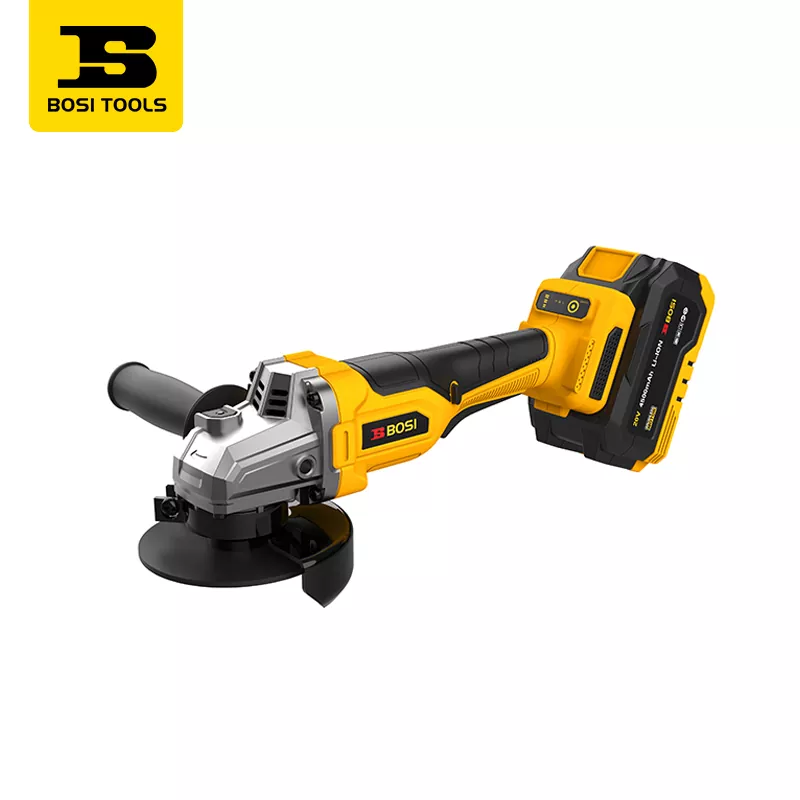
BOSI's Li-ion Brushless Angle Grinder lists a 100 mm wheel, 16 mm wheel bore, and M10 spindle thread. The 16 mm bore and M10 thread describe different parts of the mounting arrangement. They are not interchangeable dimensions, and they are not universal specifications for all grinders.
| Check | Question to resolve |
|---|---|
| Diameter and attachment form | Is this size and attachment type approved for the model and operation? |
| Bore or threaded fitting | Does the attachment match the specified locating and mounting arrangement? |
| Flanges and fastening | Are the correct parts and assembly instructions supplied? |
| Speed rating | Is the attachment rated for the grinder's maximum speed or greater? |
| Material and operation | Is cutting, face grinding, cleaning, or finishing explicitly permitted for that attachment? |
| Guard | Does the specified guard suit this approved combination? |
CCOHS portable-grinder guidance specifies that the attachment's speed rating must equal or exceed the grinder's maximum speed. It also warns against forcing an attachment onto the wrong-size grinder or altering its mounting hole.
Match the permitted operation
A cutting disc, grinding wheel, flap disc, wire brush, and diamond attachment have different working requirements. Confirm material compatibility and the permitted contact method for the exact product. Do not infer suitability from color, appearance, or the fact that an accessory can be tightened onto the spindle.
OSHA's portable power-tool guidance explains why manufacturer-approved attachments matter and warns about substituting saw blades for intended abrasive attachments. Treat the approved combination as the purchasing unit.
Corded vs. cordless angle grinders: choose for the work cycle
A corded grinder avoids battery changes but needs a suitable supply and cable arrangement. A cordless grinder can reduce setup constraints on dispersed jobs, while adding battery and charging requirements. Compare elapsed working time and acceptable output, including necessary interruptions.
Compare the complete cordless kit
List the exact battery model, capacity, charger, supplied quantity, and installed weight. A spare battery is useful only within a charging plan that suits the workload. Two batteries and one charger do not, by themselves, prove uninterrupted all-day production.
Battery capacity is not a runtime guarantee
At the same voltage basis, greater Ah represents greater nominal charge capacity, but runtime also depends on load, usable energy, pack condition, and operating limits. Do not turn a 6.0/4.0 capacity ratio into a guaranteed 1.5-times runtime claim. Measure the intended task with the specified packs.
Confirm battery and charger compatibility by exact model. Equal voltage labels do not establish electrical, mechanical, or control compatibility. Our cordless power-tool buying guide covers the broader platform and kit decision.
Keep motor type separate from power source
Brushless describes motor commutation; cordless describes the supply arrangement. A brushless motor removes the carbon-brush contact, but the complete grinder still has bearings, gearing, controls, and other service needs. Evaluate the whole product rather than assuming a motor label establishes maintenance-free operation.
Controls, safety features, and dust management
Ask what a control does before asking whether it is fitted. A push button, slide switch, and continuous-pressure control are different descriptions. A location or shape in a photograph cannot confirm the operating behavior.
Switching off and braking are different functions
Releasing a continuous-pressure switch removes drive power; stopping time depends on the machine and any fitted brake. Soft start manages startup, restart protection addresses an interrupted supply, and kickback-response features address particular operating events. Confirm each function separately for the model.
Handle the configured tool with its required handles and intended battery or cable arrangement. Grip circumference, balance, switch access, and working space can matter more than a small difference in bare-tool weight. CCOHS advises a two-handed grip and waiting until the attachment has stopped before setting the grinder down. See its portable-grinder guidance.
Choose dust control as part of the setup
Concrete and masonry work may require a compatible shroud and dust-collection system. Check fit, extraction requirements, and the task's exposure controls before selecting the machine. A generic mask or an unverified vacuum connection is not a complete equipment specification.
For the specified US construction tasks, OSHA's handheld-grinder silica fact sheet describes dust-collection systems and purpose-designed integrated water-delivery equipment. Its wet-method provisions are not permission to add water to an ordinary dry-use grinder. Follow the equipment instructions and the requirements applicable to the workplace.
BOSI angle grinder configurations compared
The following examples show why the full configuration belongs on a quotation. They are published product specifications, not a controlled performance ranking. The general size classes discussed earlier also do not mean that every size is available in every BOSI series.
| Configuration | Published power or supply | Disc diameter | No-load speed | Selection question |
|---|---|---|---|---|
| Black Warrior S1M-08-100A | 750 W | 100 mm | 11,000 r/min | Does this configuration complete the intended task and cycle? |
| Black Warrior S1M-BS11-100A | 1200 W | 100 mm | 11,000 r/min | What useful difference appears under the same working conditions? |
| Angle Grinding Machine, 150 mm options | 1600 W | 150 mm | 9000 or 8200 r/min | Which exact version and approved attachment suit the operation? |
| Angle Grinding Machine, 230 mm option | 10 A | 230 mm | 6000 r/min | Are the actual electrical configuration, reach, and handling suitable? |
| Li-ion Brushless Angle Grinder | 20 V; 4.0 or 6.0 Ah | 100 mm | Push-button: 3500/6000/8500; side-switch: 3500/6000/8000 r/min | Which switch version, pack, and working-speed combination is required? |
| Bumblebee Brushless Lithium Battery Angle Grinder | 20 V; 4.5 Ah | 100 mm | 3600/6700/8800 r/min | Does the complete supplied kit support the work cycle? |
Sources: Black Warrior corded series, Angle Grinding Machine series, Li-ion Brushless Angle Grinder, and Bumblebee series.

The two 100 mm corded examples make a useful comparison because their listed no-load speed is the same while the power ratings differ. For the cordless series, even the switch version changes the published highest speed. Keep those distinctions on the order specification rather than reducing every option to “100 mm grinder.”
I would shortlist from the customer's operation and available consumables, then compare the complete samples. That keeps a more powerful or larger configuration from being recommended for a problem caused by an unsuitable attachment or lack of access.
How to compare samples and inspection records
Use the same steel section, approved cutting-disc specification, supply conditions, and work cycle when comparing metal-cutting samples. Record acceptable cuts, elapsed time, disc consumption, and interruptions. If a configuration changes, make that change visible in the record.
Define the result before starting
For cutting, specify the section, cut position, and acceptable edge condition. For grinding, define the area or amount of material to remove and the remaining surface requirement. A faster result that needs additional rework is not the same output.
| Record | Include | Reason |
|---|---|---|
| Tool configuration | Model, disc class, speed setting, supply; exact battery and charger where applicable. | Keeps different configurations identifiable. |
| Attachment | Product specification, size, material suitability, initial condition, and mounting arrangement. | Separates accessory effects from machine effects. |
| Workpiece and fixture | Material, section, required operation, and support arrangement. | Makes the task repeatable. |
| Acceptance | Completed cuts or defined grinding result; rejects and rework. | Measures usable work rather than activity alone. |
| Time and interruptions | Working time, accessory changes, battery changes, and required pauses separately. | Shows where the full cycle is spent. |
| Consumables | Attachment consumption and replacement point under the agreed method. | Supports cost comparison. |
| Handling | Configured weight, access, grip, controls, and observed vibration. | Captures practical differences without claiming a formal vibration test. |
| Repeatability | Sample identity, repeated runs, conditions, and any deviations. | Prevents one favorable run from becoming a broad claim. |
Carry out trials within the tool and attachment instructions, with suitable supervision and controls. Do not force a stall to discover a machine's limit. A short application trial establishes behavior in that setup; it does not establish years of service life.
Read factory inspection information in context
The Black Warrior page publishes inspection items including no-load speed and spindle runout of no more than 0.05 mm. It also describes carbon-brush wear of no more than one-third of the original length after 100 hours of operation. These are supplier-published inspection criteria, not a replacement for the relevant model's test record.
Request the measurement point and method for runout, the loading and cycle for the brush test, and the identity of the tested configuration. A geometric runout check is different from a vibration-emission measurement. A brush-wear criterion is different from a whole-tool life guarantee. These distinctions help a buyer ask for evidence that answers the actual requirement.
Compare ownership cost and confirm the bulk-order configuration
Start with equivalent kits. A bare tool, a tool with one battery, and a two-battery package are different purchases. For operating cost, compare the tool allocation, consumables, labor, energy, and service against accepted output over a stated period.
Cost per acceptable cut or finished part
Use the same output definition for both options. Count rework labor and relevant interruptions without counting the same time twice. For a distributor, also separate the customer's operating savings from your own stock, service, and warranty-handling costs.
Consider an illustrative purchase with a US$20 premium and labor valued at US$15/hour. If matched trials establish a three-second saving per acceptable cut, the labor saving is 3/3600 × US$15 = US$0.0125 per cut. The premium is recovered after 1,600 acceptable cuts, provided consumable, energy, and service costs remain equal.
Illustrative labor-only break-even
ASSUMED PREMIUM
US$20
Additional purchase cost.
CONDITIONAL SAVING
US$0.0125 / cut
3 seconds at US$15/hour.
COST RECOVERY
1,600 acceptable cuts
US$20 ÷ US$0.0125.
This is a threshold for a purchasing decision. It is not proof that the saving will occur, and a power-rating ratio cannot supply the missing trial result. If the work volume never reaches that threshold, the upgrade needs another demonstrated benefit to justify its premium.
Lock the configuration before ordering
- Confirm the exact model, supply voltage, frequency, plug, and required market documents and labels.
- For cordless kits, specify the battery and charger models, quantities, and compatibility.
- List approved accessories, mounting hardware, guards, handles, and included tools.
- Agree the inspection method, acceptance criteria, and identification of the approved sample.
- Confirm the spare parts, service route, packaging, and configuration shown on the order.
BOSI Tools is Ningbo Shiji Bosi Tools Co., Ltd. For a configuration enquiry, send the material, workpiece section, required operation, expected work cycle, and available supply through the BOSI contact page or email bosi01@bosi.cn. Include the intended disc specification so the machine and accessory requirements can be reviewed together.
Frequently asked questions
What size angle grinder should I choose?
Choose the size that provides the required reach while remaining suitable for the working space and approved attachment. Confirm the actual model's cutting capacity and handling. Disc diameter alone does not specify usable cutting depth.
Is a higher-wattage angle grinder always better?
No. A higher power rating does not establish faster acceptable output, better handling, or longer life. Compare the complete configurations on the intended task, including consumable use and interruptions.
Is arbor size the same as spindle thread size?
No. An accessory's arbor size commonly describes its center bore, while spindle thread size describes a threaded mounting feature on the machine. Confirm the exact bore, thread, flanges, and fastening arrangement required by both manufacturers.
Can I fit a larger disc if I reduce the speed?
A lower speed setting does not authorize an oversized disc. Use only the attachment sizes and types approved for the model, with the specified mounting hardware and guard. Speed compatibility is only one requirement.
Does releasing the switch stop the disc immediately?
Do not assume immediate stopping. A switch can remove power while the attachment continues rotating. Check the specific control and brake functions, and wait until the attachment has completely stopped before setting down the tool.
What should distributors request before a bulk order?
Request the exact machine and kit specification, approved accessory and guard information, relevant inspection records, required market documentation, and service arrangements. Keep the approved sample and order specification aligned.
Choose the configuration that completes the work
Specify the task, confirm the approved machine-and-disc combination, and compare samples against a defined acceptable result. The configuration worth stocking is the one that fits the customer's work and can be supplied and serviced consistently.
Related News
- Cordless Impact Wrench Buying Guide: Torque, Drive Size, and Battery Selection
- Brushless vs. Brushed Drills: Differences, Performance, and Cost
- Drill Bit Types and Uses: How to Choose for Wood, Metal, and Concrete
- Hammer Drill vs. Rotary Hammer: Which Do You Need for Concrete?
- Cordless Drill Buying Guide: How to Choose the Right Drill and Kit
- How to Choose Cordless Power Tools: Specs, Batteries, and Tool Systems




-
E-mail