
- English
- Español
- Português
- русский
- Français
- 日本語
- Deutsch
- tiếng Việt
- Italiano
- Nederlands
- ภาษาไทย
- Polski
- 한국어
- Svenska
- magyar
- Malay
- বাংলা ভাষার
- Dansk
- Suomi
- हिन्दी
- Pilipino
- Türkçe
- Gaeilge
- العربية
- Indonesia
- Norsk
- تمل
- český
- ελληνικά
- український
- Javanese
- فارسی
- தமிழ்
- తెలుగు
- नेपाली
- Burmese
- български
- ລາວ
- Latine
- Қазақша
- Euskal
- Azərbaycan
- Slovenský jazyk
- Македонски
- Lietuvos
- Eesti Keel
- Română
- Slovenski
- मराठी
- Srpski језик

Cordless Drill Buying Guide: How to Choose the Right Drill and Kit
2026-10-22
Choose a cordless drill by matching its operating mode, drilling capacity, chuck, and controls to your work. Then check the battery, handling, and kit contents. A higher voltage or maximum torque figure cannot tell you whether the drill accepts your accessories, suits a finished cabinet, or can handle your masonry task.
A cordless drill is a battery-powered tool that rotates a drill bit or screwdriver bit. A drill driver handles drilling and screwdriving; a hammer-action model adds axial percussion for suitable masonry work. Those differences matter before you start comparing prices or counting accessories.
This cordless drill buying guide uses BOSI's published configurations to explain the choices. One useful comparison is unusually simple: two BOSI 20V drills are both rated at 60N·m, yet one has a 10mm chuck and ordinary drilling action, while the other has a 13mm chuck and hammer action. The same headline torque leads to different purchasing decisions.
What Will You Use Your Cordless Drill For?
Start with the material and the finished result. “Home use” can mean adjusting cabinet hinges, drilling a steel bracket, or installing fixings in a concrete wall. Those tasks ask different things of the tool.
| Regular task | Starting point | Check before buying |
|---|---|---|
| Furniture and cabinet assembly | A controllable drill driver | Clutch response, matching driver bits, head length, and access with the battery fitted |
| Pilot holes and general wood drilling | A drill driver with suitable gear ranges | Required hole diameter, bit shank, material capacity, and exit-hole finish |
| Metal brackets and sheet material | A drill rated for the material and hole size | Bit type, speed recommendations, workholding, and controlled feed |
| Occasional holes in suitable brick or masonry | A hammer-action drill rated for the application | Substrate, hole diameter and depth, masonry bit, and fixing instructions |
| Repeated or demanding concrete drilling | Assess a suitable rotary hammer | Rated concrete capacity, accessory system, and the installation's requirements |
| Repeated demanding screwdriving | Assess an impact driver alongside the drill | Fastener requirements, compatible bits, and acceptable fastening control |
Furniture assembly and everyday repairs
For small screws and finished surfaces, low-speed control can be more useful than extra maximum torque. Check whether you can start the screw smoothly, keep the bit seated, and stop at the required position. A drill that fits your hand may still be awkward inside a cabinet once a long bit is installed.
Woodworking and metal drilling
Record the material, thickness, hole diameter, depth, and bit type. A large wood-boring bit and a small metal twist drill place different demands on the same machine. Follow the accessory manufacturer's speed and application guidance; a universal “high speed for hard materials” rule is too crude for selection.
Masonry work and repeated installation
Identify the wall or slab before choosing the tool. Brick, hollow block, tile, and concrete should not be treated as interchangeable. Check the fixing manufacturer's drilling instructions as well as the drill rating. For wall work, establish where concealed services may run before making a hole.
My starting point for a drill enquiry is a short job description: “drill this material, at this diameter and depth, using this accessory.” It gives a supplier something useful to match. “Send your strongest drill” leaves the important questions unanswered.
Types of Cordless Drills: Which One Fits Your Work?
Choose the mechanism before the voltage. A bigger battery does not add a hammer mechanism to a drill driver, and an impact driver does not become a rotary hammer because its fastening torque is high.
| Tool | How it works | Where to consider it | Main selection limit |
|---|---|---|---|
| Drill driver | Continuous rotation; typically an adjustable fastening clutch | General drilling and controlled screwdriving | Material and drilling capacity; no hammer action unless specified |
| Hammer drill / combi drill | Rotation plus selectable axial percussion | Mixed drilling and suitable masonry applications | Rated substrate, hole size, and workload |
| Impact driver | Rotational impacts assist fastening under load | Demanding or repetitive screwdriving | Accessory interface and fastener control; not a substitute for a masonry hammer mechanism |
| Rotary hammer | A hammering mechanism intended for masonry drilling; commonly an SDS accessory system | Concrete drilling within the model's rating | Correct bits, operating modes, and rated capacity |
Drill drivers for holes and controlled fastening
A drill driver is a practical starting point when the job list is mainly wood, suitable metal or plastic drilling, and screws. The adjustable clutch helps with fastening, while drilling mode allows the tool to drill without the normal clutch setting limiting the operation.
Hammer action for suitable masonry work
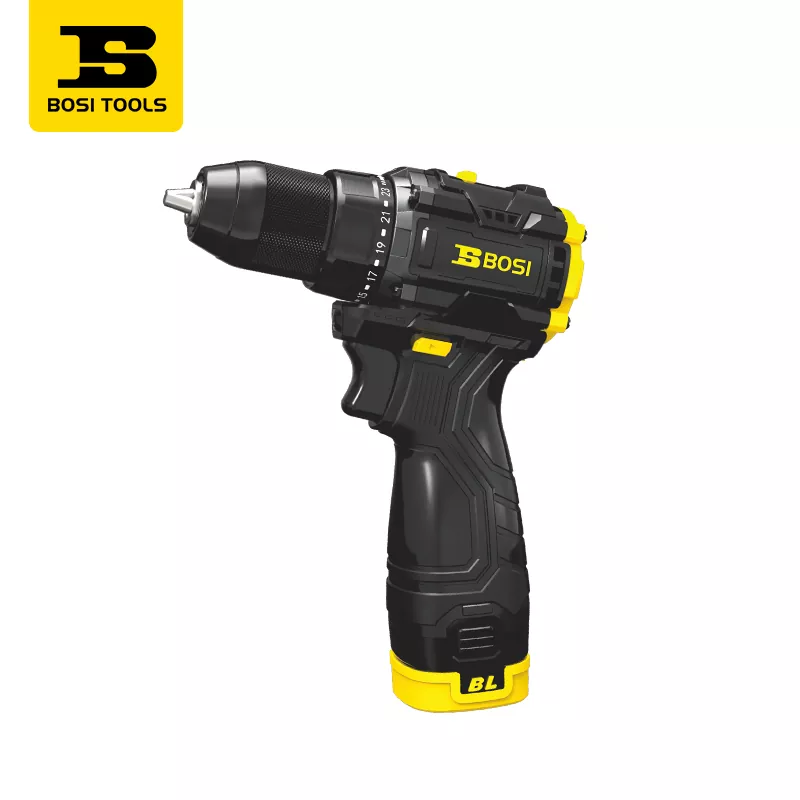
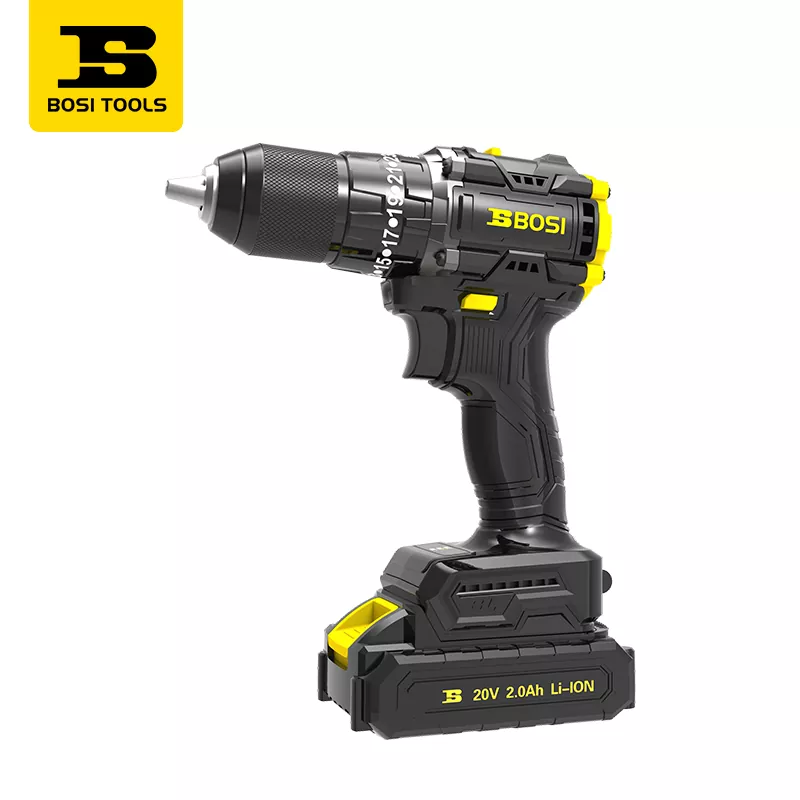
A hammer-action drill adds blows along the drilling axis. Use the operating mode and bit specified for the material. BOSI's Li-ion Brushless Impact Drill lists ordinary drilling and impact drilling modes. Despite the word “impact” in its name, it is a chuck-equipped hammer-action drill, not the hex-collet impact driver described above.
When a different tool is the better purchase
If concrete drilling dominates the workload, compare a rotary hammer's rated capacity before assuming a combi drill will cover the job. If straightness and repeatable depth are the main requirements in a workshop, consider a suitable guide or drill press. Handheld power alone does not establish hole accuracy.
For work that still suits manual tightening or frequent small adjustments, our hand tools vs. power tools guide explains how setup and access affect the choice.
3/8-Inch vs. 1/2-Inch Drill: Which Chuck Size Do You Need?
Chuck size describes the shank the chuck can hold. It does not state the maximum hole diameter the drill can produce in every material. A 3/8-inch chuck corresponds to 9.525mm by conversion; 1/2 inch is 12.7mm. Product ranges commonly use 10mm and 13mm labels. Always use the actual clamping range marked for the drill.
Compare the shank with the clamping range
A larger chuck accepts larger shanks within its stated range. That can expand accessory choices, but it does not make every accessory appropriate for the motor, gearbox, or application. A reduced-shank bit may fit while its cutting diameter demands more than the drill is rated to handle.
01 · INTERFACE
Does the bit's shank fit the chuck's actual clamping range?
02 · CAPACITY
Is the cutting diameter within the drill's rating for that material and accessory?
03 · METHOD
Are the operating mode, speed, and workholding suitable?
All three checks must agree. A shank that fits is only the first check.
When a 10mm chuck is a sensible option
A 10mm chuck may cover your intended drilling and screwdriving accessories. List the bits you actually need and compare their shanks and application requirements. If every required accessory fits and the drill meets its working capacity, a larger chuck alone is not a reason to replace it.
When to consider a 13mm chuck
Consider a 13mm chuck when your required accessories need the additional clamping range. Then compare the rest of the tool: rated capacity, gear range, control, and handling. BOSI's published configurations provide a useful 10mm-versus-13mm comparison later in this guide.
The Canadian Centre for Occupational Health and Safety's drill guidance calls for bits and attachments matched to the tool and material, and warns against exceeding the manufacturer's drilling capacities. This is the appropriate check even when an accessory physically fits.
How Much Torque and Drilling Capacity Do You Need?
Maximum torque helps describe a drill's capability, but a number in N·m does not specify a finished hole, a fastening result, or how long the drill can repeat the task. Start with the application and use torque as one comparison field.
Maximum torque needs a measurement context
When comparing quotations, ask what the stated maximum represents and whether the figures use comparable methods. A maximum, a soft-joint value, and a hard-joint value should not be treated as the same measurement. Nor does a drill's maximum torque become the installed torque in every screw.
If an assembly has a specified tightening torque, choose a controlled fastening and verification method appropriate to that requirement. A numbered drill clutch is useful for avoiding overdriving during ordinary assembly; its dial is not a calibrated torque certificate.
Match drilling capacity to the actual material
Look for separate capacities for the materials you need, with the applicable bit type and mode. If a listing gives chuck capacity but not the required material capacity, send the supplier your hole specification. Do not infer a steel or concrete drilling limit from the chuck number.
Bit diameter also affects the required operating method. Use the bit maker's speed guidance for the material and diameter, choose an appropriate mechanical gear, and secure the workpiece. An advertised no-load speed is the free-running speed range, not a promise of cutting speed under load.
Two 60N·m drills can lead to different choices
BOSI's 20V brushless drill configuration lists 60N·m maximum torque, a 10mm chuck, and ordinary drilling action. The 20V brushless impact drill also lists 60N·m, but adds hammer action and a 13mm chuck.
For a buyer assembling cabinets and drilling pilot holes, control, fit, and the necessary capacity should decide the choice. If the job list also includes suitable masonry drilling, the operating mode becomes another selection requirement. The shared 60N·m figure cannot make that decision for you.
What Do the Numbers and Settings on a Drill Mean?
The numbered collar, gear selector, trigger, and mode symbols do different jobs. Understanding them makes a drill easier to compare and helps distinguish an unsuitable setup from an underpowered tool.
| Control | What it changes | What it does not establish |
|---|---|---|
| Numbered clutch collar | The resistance threshold at which the fastening clutch slips | A universal N·m value for each number, or guaranteed screw depth |
| Drill symbol | Selects ordinary drilling, normally bypassing the fastening clutch | Unlimited drilling capacity |
| Hammer symbol, if fitted | Selects axial percussion for the specified application | Impact-driver action or suitability for every wall material |
| Mechanical gear selector | The available speed and torque range | The correct cutting RPM for every bit |
| Variable-speed trigger | Speed within the selected operating range | A replacement for choosing the appropriate gear |
| Forward/reverse selector | Rotation direction | Permission to change direction while the tool is still rotating |
Clutch numbers and the drilling position
Lower numbered settings generally let the clutch slip at lower resistance; higher settings permit more fastening torque before it slips. Start conservatively on a representative piece and adjust to the required seating result. Screw size, material, pilot hole, and friction all affect the outcome.
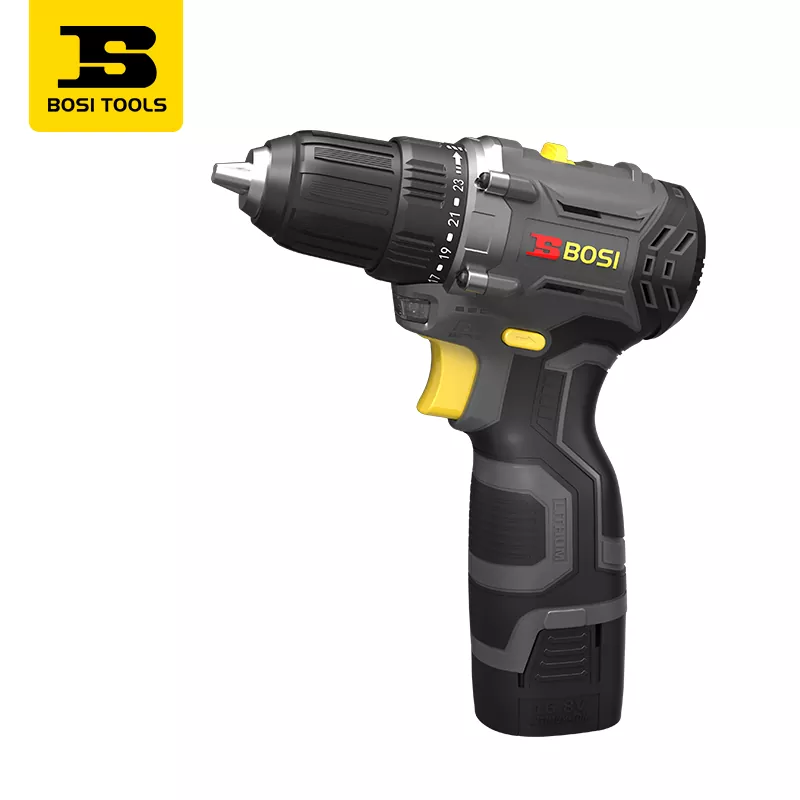
BOSI's ordinary brushless drill listing describes 23+1 settings: 23 fastening adjustments and a drilling position. These are settings, not 23 calibrated torque values. On hammer-action tools, check the manual for how the mode selector and clutch work together.
Low gear, high gear, and the trigger
The BOSI configurations compared here list 0–500 and 0–1800r/min no-load ranges. The lower gear provides the lower-speed, higher-torque range; the higher gear provides the higher-speed range. Select the gear with the tool stopped and follow the manual. Use the trigger to start and control the accessory within that range.
For hole quality, the bit and material still determine the appropriate cutting conditions. Small pilot holes, large wood-boring bits, metal drilling, and screwdriving should not all inherit the same trigger position.
Diagnose the symptom before increasing power
When a screw stops short, I would first check the bit fit and the selected mode. A clutch slipping at a low setting is doing a different job from a motor that stalls in drilling mode. Increasing the setting without identifying the cause can turn a manageable setup issue into a damaged screw or surface.
| Symptom | Check first | Practical response |
|---|---|---|
| Clutch clicks before a screw seats | Clutch setting, fastener resistance, and pilot-hole requirement | Adjust on representative material; stop if the fastener or workpiece is being damaged |
| Driver bit slips from the screw | Bit profile and size, wear, alignment, and screw condition | Use a correctly fitting bit and controlled engagement before changing the drill specification |
| Screw sinks too deeply | Clutch setting and control near seating | Reduce the setting and verify the result on a sample joint |
| Motor stops during drilling | Gear, bit sharpness, chip clearance, battery state, and rated capacity | Stop and inspect; select the correct accessory and operating method rather than forcing the tool |
| Bit slips inside the chuck | Shank seating, chuck tightening, and damaged or unsuitable parts | Isolate the tool, reseat as instructed, and remove damaged equipment from use |
Stop the tool and remove its battery before changing accessories or making adjustments. Follow the tool's instructions for clearing a jam; repeated trigger cycling is not a jam-clearing method.
Battery, Motor, and Handling: What Should You Prioritize?
Once the drill type and required capacity are clear, compare the configuration you will actually hold and recharge. A bare tool's dimensions and a battery's Ah label each describe only part of that configuration.
Compare the available voltage options within their context
The BOSI ordinary brushless drill page lists 16V/2.0Ah and 20V/2.0Ah versions, with respective maximum torque figures of 50 and 60N·m. Both list the same no-load speed ranges and a 10mm chuck. This makes the extra maximum torque a specific difference; it does not establish a proportional improvement in drilling rate or runtime.
Battery capacity in amp-hours is not a fixed number of working minutes. The accessory, material, load, pack design, and operating pattern affect usable runtime. For occasional repair work, charging convenience and replacement availability may matter more than carrying the largest pack.
Brushless motors remove one maintenance item
A brushless motor has no carbon brushes to replace. The rest of the drill still requires care: keep ventilation clear, inspect the chuck, and follow the maintenance instructions. “Brushless” alone does not establish drilling accuracy, a specific runtime advantage, or suitability for continuous heavy work.
Try the drill with the battery and accessory fitted
For a drill for tight spaces, check the complete length from the back of the tool to the working end of the installed bit. Inside a cabinet, a shorter bit may change access more than a small difference in body size. For overhead work, compare the installed weight, balance, grip, and trigger reach.
Check battery and charger part numbers rather than assuming that a shared brand or voltage means compatibility. CCOHS electrical-tool guidance specifies using the manufacturer's designated battery and a charger intended for that battery. Include those exact components when comparing quotes.
Compare BOSI Cordless Drill Configurations
The following table brings together the configurations on BOSI's linked product pages. The values are published specifications, not a timed drilling comparison. Read each column as a complete configuration.
| Specification | 16V brushless drill | 20V brushless drill | 20V brushless impact drill |
|---|---|---|---|
| Voltage label / battery capacity | 16V / 2.0Ah | 20V / 2.0Ah | 20V / 2.0Ah |
| Maximum torque | 50N·m | 60N·m | 60N·m |
| Maximum clamping diameter | 10mm | 10mm | 13mm |
| No-load speed | 0–500 / 0–1800r/min | 0–500 / 0–1800r/min | 0–500 / 0–1800r/min |
| Published torque setting | 23+1 | 23+1 | 23+1 |
| Drilling action | Ordinary drilling | Ordinary drilling | Ordinary drilling plus hammer action |
| Impact frequency | Not applicable | Not applicable | 0–7500 / 0–27000IPM |
| Motor | Brushless | Brushless | Brushless |
| Product details | Li-ion Brushless Drill | Li-ion Brushless Impact Drill | |
Choose the configuration that meets the task
For screwdriving and ordinary drilling, compare the 16V and 20V versions against your required capacity and handling. The published 50-versus-60N·m difference gives you one comparison point. It does not make the lower figure unsuitable for all trade work or the higher figure necessary for every household.
For suitable masonry work, assess the hammer-action model's rated application as well as its additional function. IPM means impacts per minute; it counts the hammering rate, not the energy of each impact or the number of completed holes.
A practical selection example
Consider a maintenance buyer assembling cabinets, making pilot holes in timber, and occasionally installing brackets into brick. The first two tasks put ordinary drilling, bit fit, and clutch control on the checklist. The brick task adds a need to confirm hammer action, a suitable masonry bit, and the required hole specification.
The buyer can then compare an ordinary drill with a separate masonry tool against a suitable hammer-action drill. If the work changes to repeated concrete anchoring, the tool assessment changes again. This is why a job list is more useful than a blanket recommendation for one voltage class.
How to Choose a Cordless Drill Set for Home Use
Choose a drill set by the jobs its contents can complete, then check what is missing. “Cordless drill set” may describe a drill with batteries, a drill-and-impact-driver combo, or a case containing a drill and assorted hand tools. A drill-bit set is a separate accessory purchase and may contain no power tool at all.
Bare tool, drill kit, or multifunctional tool set?
A bare tool can make sense when you already own the exact compatible batteries and charger. Read the listing: do not assume either is included. A starter kit is useful when you need the drill and its charging equipment together. A multifunctional set is worth assessing when the work also needs measuring, gripping, cutting, and manual tightening tools.
Compare the complete cost of a usable setup. A lower-priced bare drill still needs a compatible pack, charger, and working accessories. Conversely, a large set may duplicate tools you already have.

What the BOSI 79-piece set adds
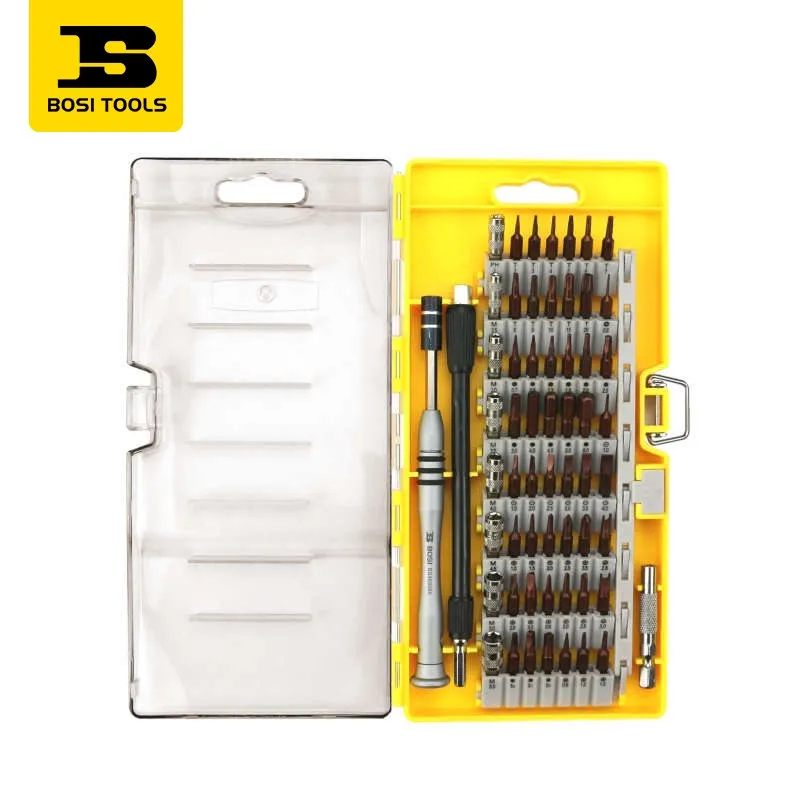
The 79-piece Multifunctional Lithium Drill Set lists a 12V dual-speed drill, two lithium batteries, and one charger. The published contents also include sockets, hex keys, pliers, an adjustable wrench, a hammer, a tape measure, driver accessories, twist drill bits, and electrical test instruments.
That combination gives a home-repair buyer a different starting point from a drill-only kit. It provides tools for other stages of the job, such as measuring and manual tightening. Electrical test instruments require suitable ratings and competent use; their presence in the case does not make every electrical task appropriate for a home user.
The product page specifies that this drill has no impact function. More accessories do not change that mechanism. If the regular task includes concrete drilling, select an appropriate tool and accessory for that task rather than assuming the case contains a solution.
| Kit item | What to verify |
|---|---|
| Drill | Exact configuration, operating modes, chuck range, and capacity for the required material |
| Batteries | Quantity, part number, capacity, replacement availability, and fit with the supplied tool |
| Charger | Battery compatibility and input rating and plug for the intended destination |
| Drill bits | Material suitability, cutting diameter, shank, usable length, and required operating mode |
| Driver bits and holders | Profiles and sizes matched to the fasteners; impact rating where required |
| Hand tools and measuring tools | Whether they serve your regular jobs or duplicate existing equipment |
| Case | Secure retention, working latches, clear tool locations, and space for the agreed contents |
Check the gaps before choosing the larger set
A kit may still need a particular bit diameter, a depth stop, a guide, or suitable workholding. List those additions before deciding which set offers better value. A useful kit is one you can put to work with a clear understanding of its limits.
What Should You Check Before Buying or Ordering Samples?
Use representative work to compare the complete setup. For a personal purchase, a handling demonstration may resolve the main questions. For repeated installation or a bulk order, agree a sample check that uses the intended tool, battery, bits, and materials.
Keep comparison conditions consistent
Record the drill configuration, battery and starting charge, bit specification and condition, material and thickness, hole diameter and depth, mode, and gear. If you compare elapsed time, record the procedure and include any pauses or battery changes. Otherwise a quicker result may simply reflect a different bit or a shallower hole.
I would check completion quality and control before comparing speed. A screw seated incorrectly or a hole outside the required position is not a useful productivity gain. For a buyer, the meaningful result is acceptable work produced with a setup the operator can control.
| Check | What to record | What it helps decide |
|---|---|---|
| Representative fastening | Fastener and material, pilot hole, setting, seating result, and visible damage | Whether control and the chosen setup suit the assembly |
| Representative hole | Bit, material, diameter, depth, finish, and ability to complete the hole | Whether the rated application and practical result meet the task |
| Accessory retention | Correct installation and any slipping or unusual vibration during permitted work | Whether the chuck and accessory combination needs attention |
| Handling | Battery fitted, working position, access, balance, and trigger response | Whether the configuration can be controlled in the intended space |
| Kit inspection | Agreed contents, battery and charger labels, case retention, and instructions | Whether the delivered configuration matches the order |
Operate within the manufacturer's instructions and rated capacity. Secure the workpiece, use appropriate eye protection, and inspect the battery and tool before use. CCOHS's powered-drill guidance provides a useful reference for these checks.
For bulk orders, match the documents to the configuration
Request the relevant instructions, supplied-component list, and applicable compliance documentation for the exact tool, battery, charger, and destination. A brand name or a general factory certificate does not identify the supplied configuration.
For example, the IEC 62841-2-1 public scope covers hand-held drills and impact drills and explicitly excludes rotary hammers. Use the correct tool category when discussing documentation; the existence of a standard is not evidence that a particular model has been certified to it.
For a BOSI enquiry, send your material, hole or fastener size, usage pattern, preferred kit contents, and destination market. You can contact BOSI Tools or email bosi01@bosi.cn to discuss the matching configuration. Include battery and charger requirements so the comparison covers a usable set.
Cordless Drill Buying FAQs
Is a 3/8-inch drill enough for home use?
It can be, when the required accessory shanks fit and the drill's material capacity covers the work. Check the actual clamping range and intended hole sizes. Choose a larger chuck when the accessories require it, rather than treating chuck size alone as a quality grade.
Do higher clutch numbers mean a specific torque?
No. Higher numbers generally permit more resistance before the clutch slips, but the numbers are not universal N·m settings. Check the tool's instructions and adjust on representative material. Use an appropriate controlled method when the assembly specifies a tightening torque.
Can a cordless drill drill concrete?
Some hammer-action cordless drills are rated for specified concrete applications; ordinary drill drivers should not be assumed suitable. Check the tool's concrete capacity, bit, hole size and depth, and the fixing instructions. For repeated or demanding concrete work, assess a suitable rotary hammer.
Does a cordless drill set include batteries and drill bits?
The name alone does not confirm the contents. Read the item list for battery quantity, charger, drill bits, and driver accessories. BOSI's 79-piece multifunctional set lists two batteries and a charger, but other packages can differ.
What makes a cordless drill suitable for a beginner?
A suitable beginner drill meets the intended tasks and is easy to control with the battery installed. Check low-speed starting, clutch adjustment, grip, accessory changes, and clear instructions. More maximum torque is not a substitute for those checks.
Should I choose a drill by voltage or torque?
Choose the tool type and required material capacity first. Then compare voltage, torque, gear ranges, chuck, battery, and handling within the available configurations. Either number on its own leaves important parts of the selection unresolved.
Related News
- Hammer Drill vs. Rotary Hammer: Which Do You Need for Concrete?
- How to Choose Cordless Power Tools: Specs, Batteries, and Tool Systems
- Hand Tools vs Power Tools: Differences, Examples, and When to Use Each
- How Li-ion Cordless Blower Vacuum Reflects the Shift to Battery-Powered Garden Tools
- What Are Steel Stranded Cable Cutters and How Do They Work?
- How Do D-Type Bolt Cutters Deliver Clean, Reliable Cuts?


-
E-mail