
- English
- Español
- Português
- русский
- Français
- 日本語
- Deutsch
- tiếng Việt
- Italiano
- Nederlands
- ภาษาไทย
- Polski
- 한국어
- Svenska
- magyar
- Malay
- বাংলা ভাষার
- Dansk
- Suomi
- हिन्दी
- Pilipino
- Türkçe
- Gaeilge
- العربية
- Indonesia
- Norsk
- تمل
- český
- ελληνικά
- український
- Javanese
- فارسی
- தமிழ்
- తెలుగు
- नेपाली
- Burmese
- български
- ລາວ
- Latine
- Қазақша
- Euskal
- Azərbaycan
- Slovenský jazyk
- Македонски
- Lietuvos
- Eesti Keel
- Română
- Slovenski
- मराठी
- Srpski језик
Hammer Drill vs. Rotary Hammer: Which Do You Need for Concrete?
2026-10-22
A hammer drill adds short axial impacts to rotation; a rotary hammer uses a dedicated hammering mechanism to deliver blows to the bit. For occasional masonry holes within the tool's rated capacity, a hammer drill may be enough. For repeated concrete drilling, start by evaluating a rotary hammer. Choose the complete setup by material, hole diameter, depth, quantity, and accessory compatibility.
A tool can have a higher speed on its label and still be the wrong choice for the hole. Our recommendation is to define the finished hole first, then match the machine, bit, operating mode, and dust control to it. This matters whether you are buying one concrete drill or specifying a range for distributors and installation teams.
Hammer drill vs. rotary hammer: key differences
The main difference between a hammer drill and a rotary hammer is how the impact reaches the bit. Housing size, corded or cordless power, and the word “hammer” on a box do not tell the whole story.
| Feature | Hammer drill | Rotary hammer |
|---|---|---|
| Typical impact mechanism | Interacting toothed plates generate short axial movements. | A piston and air cushion drive a striker in a common electropneumatic design. |
| Typical drilling role | Mixed ordinary drilling and occasional masonry drilling, within the model's ratings. | Concrete drilling where the task calls for a dedicated hammering system. |
| Tool holder | Commonly a three-jaw chuck. | Often an SDS-family holder; the exact interface must match the accessory. |
| Operating modes | Usually rotation only and hammer drilling. | Model dependent: rotary hammering, with rotation-only and/or hammer-only options on some models. |
| Purchase check | Material-specific drilling capacity, speed control, chuck, and handling. | Working capacity, impact specification, interface, modes, and handling. |
What is a hammer drill, and how does it work?
A conventional hammer drill rotates the bit while a pair of toothed plates produces rapid, short movements along the drilling axis. With the hammer action disengaged, a combination drill can perform ordinary rotary drilling. Its masonry function must be used with a suitable bit and within the manufacturer's capacity limits.
What is a rotary hammer, and what is it used for?
In a common rotary hammer mechanism, a motor drives a piston. Changes in air pressure move a striker, which transfers blows to the bit through an impact piece. A separate drive path rotates the bit. This arrangement suits concrete drilling; a model with a suitable hammer-only mode can also perform specified chiseling work.
How the impact reaches the bit
HAMMER DRILL
Rotating toothed plate
↓
Interaction with fixed plate
↓
Short axial movement at the bit
ROTARY HAMMER
Driven piston
↓
Air cushion → striker
↓
Impact piece → bit
Impact drill, impact driver, and regular drill: which is which?
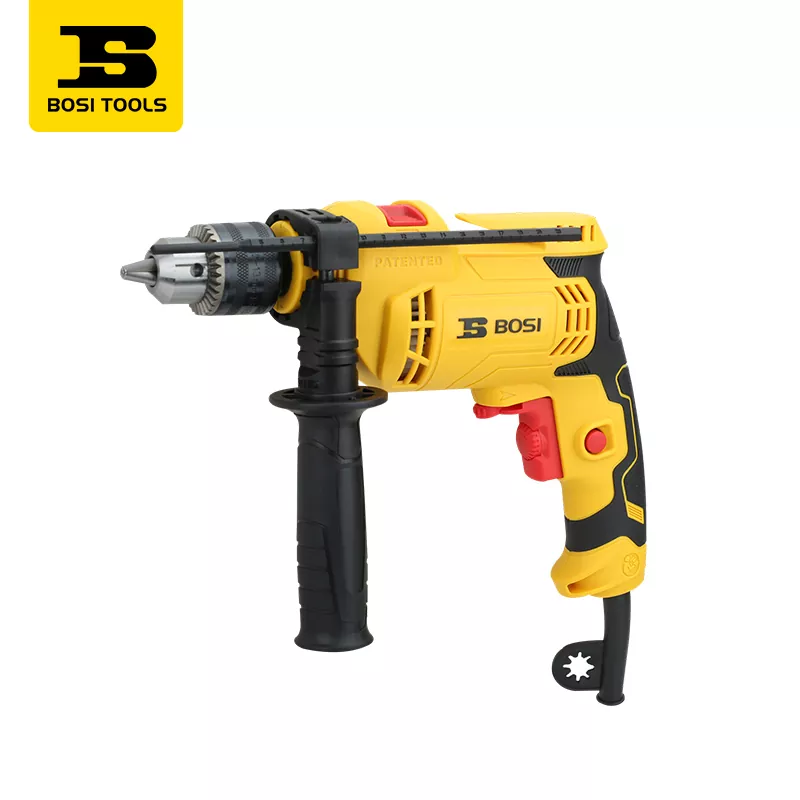
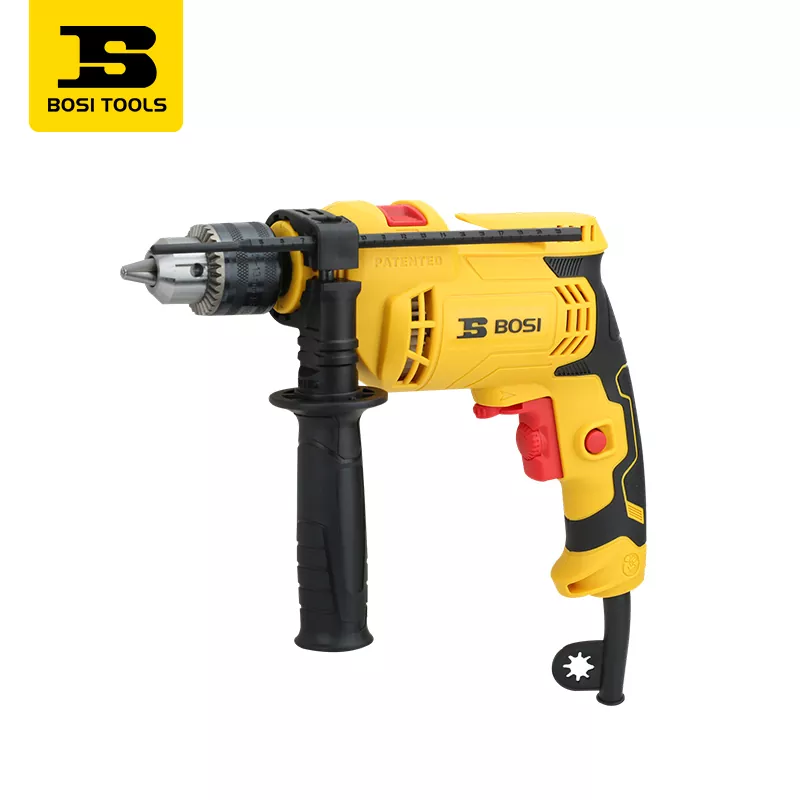
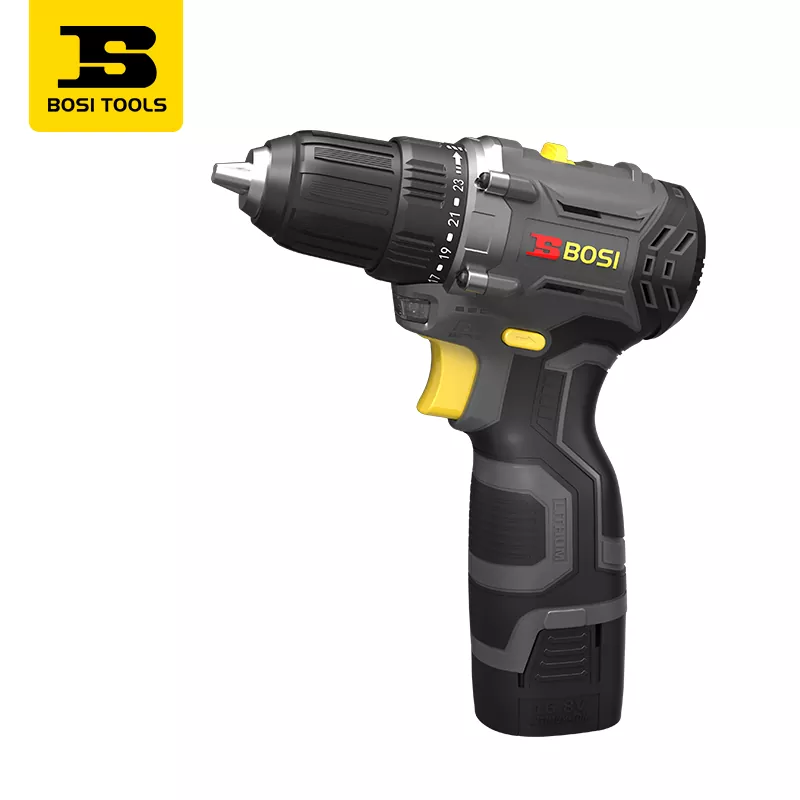
Impact drill is used in some catalogs for a hammer-action drill, including the BOSI Impact Drill below. An impact driver applies rotational impacts for fastening. The similar names do not make their actions interchangeable.
A regular drill or drill driver primarily rotates the bit. “Rotary drill” can simply mean rotation-only drilling, so a comparison titled “rotary drill vs. hammer drill” may be discussing a regular drill rather than a rotary hammer. Look for the mechanism, holder, and mode description.
The distinction also appears in safety-standard scopes. IEC 62841-2-1 covers drills and impact drills and excludes rotary hammers. IEC 62841-2-6 covers hand-held hammers, including rotary hammers. When requesting product compliance documents, match them to the exact model, applicable edition, and destination market.
Do you need a hammer drill or a rotary hammer for concrete?
A hammer drill can drill concrete when the model, bit, and hole requirements allow it. For recurring concrete work, a rotary hammer is generally the more relevant tool class to assess. There is no single hole diameter that separates every hammer drill from every rotary hammer.
Brick, block, and concrete: start with the material
“Masonry” covers materials with very different behavior. Solid brick, hollow block, and dense concrete should not share one automatic setting. A mode that makes useful progress in concrete may damage the thin walls of a hollow unit or the surface of a fragile finish. Follow the drilling method specified for the substrate and fixing system.
For a tiled wall, identify the layers. The method for passing through the tile can differ from the method for drilling the material behind it. Select the bit and mode for the layer being cut; the presence of concrete behind a finish does not make hammer action suitable at the surface.
Hole diameter, depth, and quantity
A few shallow holes and a series of deep holes can have the same diameter but very different demands. Greater depth changes bit-length and debris-removal requirements. Repeated work makes handling, temperature, dust collection, and necessary pauses part of the purchase decision.
From a supply perspective, we recommend starting the discussion with four details: base material, hole diameter, drilled depth, and number of holes per work period. Then add the fixing specification and working position. This produces a much more useful selection brief than “a powerful drill for concrete.”
| Task | Starting point | Deciding check |
|---|---|---|
| Occasional small holes in solid masonry | Evaluate a suitable hammer drill. | Rated capacity for the actual substrate, bit, and fixing method. |
| Repeated holes in concrete | Evaluate a rotary hammer and compatible extraction. | Hole size and depth, working range, handling, and performance over the planned sequence. |
| Hollow block or fragile masonry | Follow the substrate and anchor drilling method. | Whether impact is allowed and how hole damage will be checked. |
| Deep or large-diameter holes | Check the complete drilling system before choosing a model. | Rated capacity, accessory length, debris removal, and whether a different drilling method is specified. |
| Tile removal or local light chiseling | Consider a model with an approved hammer-only mode. | Chisel interface, permitted application, and surrounding material. |
Concrete walls, floors, and slabs: what changes?
For concrete walls, the working height, tool length, and access around the handle affect whether the operator can maintain alignment. For floors and slabs, the required depth and the location of embedded services, reinforcement, or post-tensioning must be established before drilling. A concrete-floor application does not by itself justify a larger hammer.
Consider two planning examples: a small set of approved fixing holes in solid brick, and repeated anchor holes in concrete. The first may favor a hammer drill that also serves ordinary drilling tasks. The second justifies evaluating a rotary hammer with the specified bit and dust-control arrangement. These are selection scenarios; the actual fixing instructions and tool ratings determine the final configuration.
How to read watts, RPM, BPM, and impact energy
A useful specification comparison keeps each number attached to the quantity it measures. Input power, rotation, impact frequency, and impact energy are different properties.
| Specification | What it tells you | What it cannot establish alone |
|---|---|---|
| Rated input power, W | The tool's labeled electrical input power rating. | Energy delivered in each blow, drilling speed, or service life. |
| No-load speed, RPM or r/min | Rotational speed without the drilling load. | Speed under load or time to complete a concrete hole. |
| Impact rate, BPM or IPM | Number of blows or impacts per minute under the stated conditions. | Strength of each blow or suitability for a particular fixing hole. |
| Single-impact energy, J | Energy associated with an individual impact under the stated measurement method. | Overall productivity across different bits, materials, and test methods. |
| Maximum drilling diameter, mm | A capacity limit in its specified material and accessory context. | A recommended diameter for every material or continuous work at that limit. |
A faster spindle does not settle the concrete comparison
The BOSI J1Z-BS02-13 lists a no-load range up to 3300 r/min, while the Z1C-BS09-26 lists 1150 r/min. Those values describe rotation in two different tool systems. They do not show which machine completes an anchor hole sooner.
The same caution applies to BPM. Many small impacts and fewer larger impacts are not equivalent just because one frequency is higher. A comparison needs the mechanism, bit, material, and drilling result as well as the speed label.
Joules require a defined measurement
If impact energy is part of a procurement specification, request the declared value and measurement basis for each model. Do not derive joules per blow by dividing the motor's electrical input power by an impact-rate figure: the input does not all become energy delivered at the bit, and the operating conditions may differ.
Maximum capacity and the work you repeat
A maximum diameter is a limit to interpret, not a target to select automatically. Ask which material and accessory it describes, then check the expected working range for your actual holes. Core drilling and solid-bit drilling can have different limits.
CCOHS drill guidance advises matching accessories to the material and tool capacity and staying within the manufacturer's recommended maximum capacities. Drilling a pilot hole does not authorize exceeding those limits.
SDS drill vs. hammer drill: chucks, bits, and modes
“SDS drill” commonly refers to a rotary hammer fitted with an SDS-family tool holder. SDS identifies an interface system; the drilling mechanism and selectable modes still need checking. The drill bit must match both the holder and the work.
Match the shank to the tool holder
A three-jaw chuck grips the accessory shank between jaws. An SDS-family holder engages the matching shank features while allowing the axial movement needed by the hammering system. SDS-Plus and SDS-Max are distinct interfaces and are not directly interchangeable.
Also separate shank fit from cutting suitability. A bit that locks into the holder may still be the wrong type for the material, the selected mode, or the specified hole. “Masonry bit” is not enough information if its packaging restricts it to rotary-only use.
| Accessory arrangement | Check before use | Mode decision |
|---|---|---|
| Straight-shank bit in a three-jaw chuck | Permitted shank size, secure clamping, material, and impact suitability. | Rotation only or hammer drilling, as allowed by the bit and drill. |
| Matching SDS-family masonry bit | Exact interface, approved bit dimensions, and tool capacity. | Use the mode specified for the bit and substrate. |
| Chisel in a rotary hammer | Correct shank and a tool that supports the application. | Hammer only; an angle-setting position is not a drilling mode. |
| Three-jaw chuck attached through an adapter | Approval for the tool, adapter, chuck, and accessory combination. | Common conventional arrangements require rotation-only use. Follow their explicit restrictions. |
What changes when you select a different mode?
Three motions, three different jobs
↻
ROTATION ONLY
Bit turns without hammer action. Choose the cutting tool and speed for the material.
↻ + ↔
ROTARY HAMMERING
Bit turns while receiving axial blows. Used for compatible masonry drilling tasks.
↔
HAMMER ONLY
Blows without driven rotation. For approved chiseling work with the correct accessory.
Change modes only as instructed for the machine. The BOSI three-function model specifies stopping completely before switching. For fitting or changing an accessory, disconnect the power supply. Before starting, check that the selector is engaged in its working position and the accessory is retained correctly.
An adapter is useful only if it preserves an approved combination. It does not increase the tool's capacity or make an ordinary drill bit suitable for hammering.
BOSI hammer drill vs. rotary hammer: two configurations compared
The BOSI J1Z-BS02-13 Impact Drill and Z1C-BS09-26 Three-Function Drill Hammer show why a purchasing comparison should include operating modes alongside power and speed.
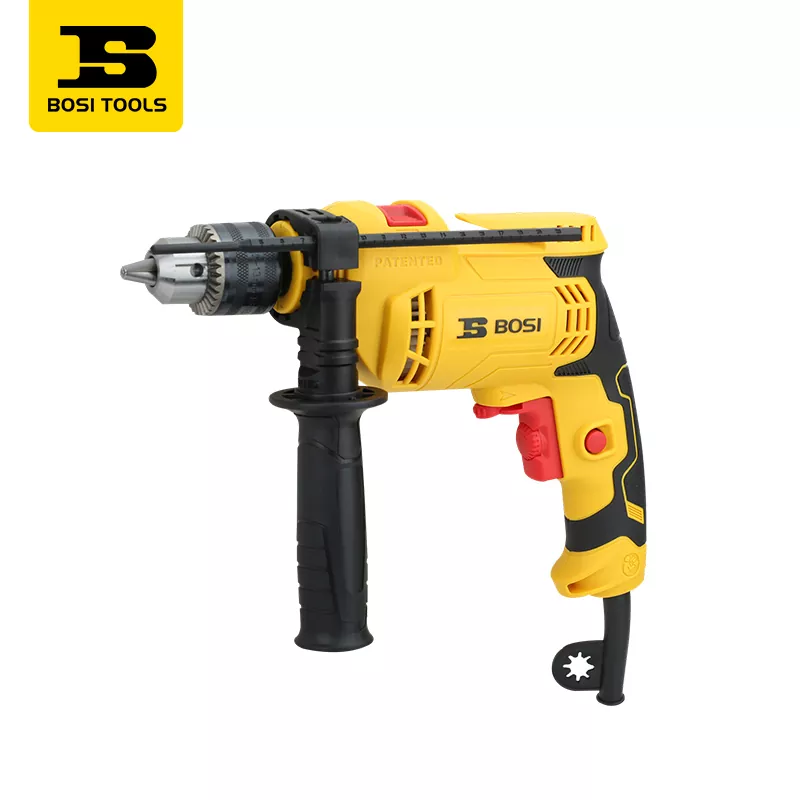
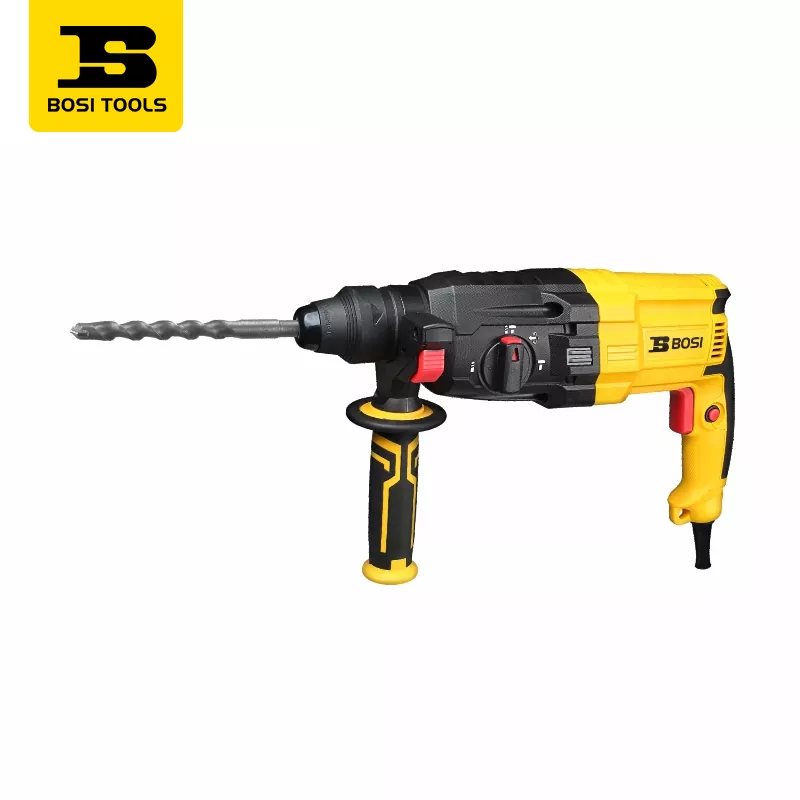
| Item | J1Z-BS02-13 Impact Drill | Z1C-BS09-26 Three-Function Drill Hammer |
|---|---|---|
| Rated power | 710 W | 900 W |
| Rated voltage / frequency | 220 V / 50 Hz | 220 V AC / 50 Hz |
| No-load speed | 0-3300 r/min | 1150 r/min |
| Published maximum drilling diameter | 13 mm | 26 mm |
| Functions | Ordinary drilling and impact drilling. | Ordinary drilling, rotary hammering, and hammer-only chiseling. |
| Accessory detail | Three-jaw chuck shown in the product photo. | Product page describes a round-shank SDS interface; match the exact shank specification when ordering. |
| Ordinary wood or metal drilling | Select rotation-only mode with an appropriate bit. | The product page specifies a separately sold three-jaw chuck arrangement for this use. |
The 13 mm and 26 mm entries are the product pages' stated maximum drilling diameters. For an order, specify the material and bit type alongside the required capacity; do not treat either entry as a complete material-by-material drilling chart.
What these figures mean for a buyer
The 710 W model is worth evaluating when ordinary drilling and intermittent masonry work share the same toolkit. The 900 W three-function model deserves attention when the work includes concrete drilling and approved light chiseling. Its additional mode can change the range of tasks covered, even though its published rotational speed is lower.
For the Z1C-BS09-26, BOSI describes tile removal and light wall work as hammer-only applications and directs heavy breaking to a suitable dedicated tool. That distinction matters: owning a chisel attachment does not turn a light rotary hammer into a general demolition machine.
For export orders, match the supplied voltage and frequency to the intended installation. The configurations above are listed at 220 V and 50 Hz. Packaging artwork, plug format, accessory contents, and the exact model documentation should describe the configuration actually being purchased.
Why is your drill making slow progress?
Slow progress is a symptom, not a diagnosis. Before replacing a tool with a higher-wattage model, check whether the current setup is doing the intended work.
Our suggested inspection order is mode, bit, holder, hole conditions, then capacity. It helps separate a setup error from a task that calls for a different machine. Increasing pressure before checking these items can leave the original problem unresolved.
| Observation | What to check | Next decision |
|---|---|---|
| The bit turns but makes little progress from the start | Selected mode, bit suitability and condition, and whether the exposed surface matches the expected material. | Correct the setup within the tool and accessory instructions. |
| Progress falls as the hole becomes deeper | Usable bit length, debris evacuation, and the intended hole depth. | Review the prescribed drilling and cleaning method before continuing. |
| The accessory slips or runs visibly out of true | Shank compatibility, seating, chuck condition, and accessory damage. | Isolate power and correct the fit or replace damaged components. |
| Progress stops abruptly at one location | Possible obstruction, reinforcement, or a change in substrate. | Stop and establish the cause. Get the responsible person's approval before altering a designed fixing position or drilling method. |
| Repeated stalling, abnormal heat, or unusual noise | Workload versus rating, accessory condition, ventilation, and the tool's inspection requirements. | Stop and inspect as directed by the manufacturer; do not use repeated stalling as a performance test. |
A stalled bit is not proof that the tool needs more impact energy. It may be jammed, damaged, or meeting an obstruction. CCOHS specifically advises against trying to free a jammed bit by cycling the drill on and off. Disconnect the tool and follow the approved recovery procedure.
Where reinforcement or concealed services are suspected, a more aggressive bit is not the next automatic step. The drilling location and intended fixing may need assessment. The aim is an acceptable hole in an approved position, not simply getting through the obstruction.
Dust extraction, chip removal, and anchor hole cleaning
These tasks happen around the same hole but serve different purposes. A purchase specification should address each one.
Chip removal keeps the drilling process working
The drill bit's flutes provide a route for loosened material to leave the hole. Depth and debris buildup can affect progress, so choose a suitable working length and follow the bit manufacturer's drilling procedure. Do not assume that a clear entrance means the bottom of the hole is clear.
Dust extraction controls material released into the air
Drilling concrete and masonry can generate respirable crystalline silica dust. OSHA's handheld and stand-mounted drill fact sheet describes source capture using a compatible shroud or cowling connected to a suitable vacuum. The tool, airflow, filter, and maintenance arrangement work together. The guidance concerns US construction; apply the requirements for your own worksite.
Include the extraction arrangement when checking access and drilling position. A bare tool that fits beside a bracket may have less clearance once the bit and dust collector are fitted.
Anchor hole cleaning prepares the hole for the fixing
An anchor system can specify its own cleaning sequence, equipment, and installation conditions. Follow that product's instructions for the selected drilling method. Source capture during drilling does not automatically replace the specified hole-cleaning process.
OSHA's fact sheet also addresses capturing dust and debris during hole cleaning with a HEPA-filtered vacuum. Coordinate exposure controls with the anchor installation method rather than improvising a universal blowing or brushing routine.
How to compare tools before a bulk purchase
For a distributor or project buyer, a sample comparison should answer whether the proposed configuration performs the intended work reliably enough for the order. A single impressive hole does not establish suitability across a whole work period.
Set the conditions before timing anything
Write down the substrate, approved hole diameter and depth, accessory model, operating mode, power supply, and dust-control method. Keep the operator and working position consistent where practical. If the two tools require different shank systems, record both bit designs and their condition; identical tip diameter alone does not create an identical test.
Choose acceptance criteria before the comparison: required position and depth, the fixing manufacturer's hole requirements, and an acceptable process without abnormal tool behavior. Use the specified inspection method rather than judging every hole by appearance.
| Record | Why it belongs in the comparison |
|---|---|
| Exact tool and accessory configuration | Connects the result to something that can be ordered again. |
| Substrate and hole requirements | Prevents a result in one material or depth being generalized to another. |
| Preparation, drilling, cleaning, and inspection time | Shows the time needed to produce a usable result. |
| Pauses, accessory changes, and rejected holes | Captures interruptions that a stopwatch on the trigger would miss. |
| Handling with accessories and extraction fitted | Tests access, grip, and alignment in the actual working position. |
| Manual, model label, and relevant documentation | Checks that instructions and supplied configuration match the purchase specification. |
Measure the complete working cycle
For a planned sequence of holes, count preparation, drilling, cleaning, inspection, accessory changes, and necessary pauses. If one setup drills faster but requires more handling or rework, that difference belongs in the result.
A useful productivity measure
Elapsed time for the agreed work sequence ÷ accepted holes
Ask for results per hole as well as the total, so a fast first hole does not hide a later decline. Separate actual observations from explanations that still need investigation. For example, “progress slowed after the sixth hole” is a record; “the motor is too weak” is a diagnosis requiring more evidence.
Compare ownership costs using the same scope
Put the tool, compatible bits, any approved adapter, extraction equipment, and expected service items on the same quotation sheet. A lower bare-tool price can be a poor comparison if it omits equipment needed for the work. For occasional use, access to a suitable rental tool may also be worth considering; repeated work puts more weight on accessory availability and support.
For a wider view of manual and powered work methods, see our hand tools vs. power tools guide.
Frequently asked questions
Can you use a hammer drill as a regular drill?
Yes, if the model provides a rotation-only mode and is suitable for the accessory and task. Disengage the hammer action for ordinary drilling where impact is inappropriate. The BOSI J1Z-BS02-13 lists both ordinary drilling and impact modes.
Is an impact drill the same as a hammer drill?
In many catalogs, “impact drill” describes a drill with axial hammer action. Check the function rather than relying on the name. An impact driver uses rotational impacts for fastening and is a different tool category.
Can you use regular drill bits in a rotary hammer?
Only with a holder or approved chuck-and-adapter arrangement that accepts the shank, using the permitted mode. Conventional three-jaw adapter arrangements commonly require rotation-only operation. Check the tool, adapter, chuck, and bit instructions together.
Can a rotary hammer be used for chiseling?
A model with an appropriate hammer-only mode can use compatible chisels for its approved applications. Not all rotary hammers offer that mode. The BOSI Z1C-BS09-26 includes hammer-only operation for specified light chiseling tasks.
What is the difference between a rotary hammer and a demolition hammer?
A rotary hammer combines rotation and hammering for drilling and may also offer chiseling. A demolition hammer is intended for hammering and breaking without rotary drilling. Select a dedicated breaking tool when the work exceeds the rotary hammer's approved chiseling applications.
Does a higher BPM mean faster concrete drilling?
No. BPM counts impacts per minute; it does not give their energy. Progress also depends on the mechanism, bit, material, hole dimensions, and operating conditions. Compare completed, acceptable holes under defined conditions.
Specify the hole before you specify the tool
For occasional masonry work, evaluate a suitable hammer drill. For recurring concrete drilling or approved light chiseling, assess a rotary hammer with the necessary modes and accessories. Match the complete setup to the work before comparing price or headline power.
For BOSI product selection, send the base material, hole diameter, drilled depth, expected workload, and destination voltage through our official contact page or email bosi01@bosi.cn. Include required bits and dust-control accessories so the configuration can be discussed as a complete working setup.
Related News
- Cordless Drill Buying Guide: How to Choose the Right Drill and Kit
- How to Choose Cordless Power Tools: Specs, Batteries, and Tool Systems
- Hand Tools vs Power Tools: Differences, Examples, and When to Use Each
- How Li-ion Cordless Blower Vacuum Reflects the Shift to Battery-Powered Garden Tools
- What Are Steel Stranded Cable Cutters and How Do They Work?
- How Do D-Type Bolt Cutters Deliver Clean, Reliable Cuts?

-
E-mail