
- English
- Español
- Português
- русский
- Français
- 日本語
- Deutsch
- tiếng Việt
- Italiano
- Nederlands
- ภาษาไทย
- Polski
- 한국어
- Svenska
- magyar
- Malay
- বাংলা ভাষার
- Dansk
- Suomi
- हिन्दी
- Pilipino
- Türkçe
- Gaeilge
- العربية
- Indonesia
- Norsk
- تمل
- český
- ελληνικά
- український
- Javanese
- فارسی
- தமிழ்
- తెలుగు
- नेपाली
- Burmese
- български
- ລາວ
- Latine
- Қазақша
- Euskal
- Azərbaycan
- Slovenský jazyk
- Македонски
- Lietuvos
- Eesti Keel
- Română
- Slovenski
- मराठी
- Srpski језик
Can a Li-ion Air Blower Replace Traditional Gasoline Blowers?
2026-11-09
Can a Li-ion Air Blower Replace Traditional Gasoline Blowers? With advances in brushless motor technology and lithium-ion batteries, cordless air blowers are becoming practical alternatives for many cleaning and maintenance tasks. In this article, we compare airflow, operating time, maintenance, portability, and application scenarios. Drawing on the specifications of BOSI Tools' 20V Li-ion Brushless Air Blower, we explain where battery-powered equipment performs well and where gasoline models still have an advantage.
Table of Contents
- Why Are Users Considering Battery-Powered Air Blowers?
- Li-ion Air Blower vs. Gasoline Blower: Performance Comparison
- How Does Brushless Motor Technology Improve Performance?
- How Long Can a 20V Lithium Battery Air Blower Operate?
- Which Applications Are Suitable for a Cordless Air Blower?
- When Is a Gasoline Blower Still the Better Choice?
- How Does BOSI Tools Meet Different Cleaning Requirements?
- Frequently Asked Questions
Why Are Users Considering Battery-Powered Air Blowers?
For years, gasoline blowers have been widely used in landscaping, construction, and outdoor maintenance. Their ability to operate continuously after refueling makes them suitable for demanding jobs over large areas. However, fuel consumption, engine maintenance, exhaust emissions, and starting procedures can increase the workload for daily operators.
We have seen growing interest in cordless cleaning equipment as users look for more flexible ways to handle routine maintenance. A modern lithium-ion air blower eliminates the need for gasoline and extension cords, while its rechargeable battery makes it easier to move between different working areas.
The change is not simply about replacing one power source with another. Motor efficiency, airflow design, battery capacity, and actual working conditions all determine whether a battery-powered model can handle a particular task.
For example, removing dust from a factory floor is different from clearing wet leaves across a large landscape. The first task requires convenient and controlled airflow, while the second demands stronger blowing force and longer operating time.
Li-ion Air Blower vs. Gasoline Blower: Performance Comparison
When comparing these two types of equipment, we recommend looking beyond maximum wind speed. Airflow volume, operating duration, equipment weight, and maintenance requirements are equally important.
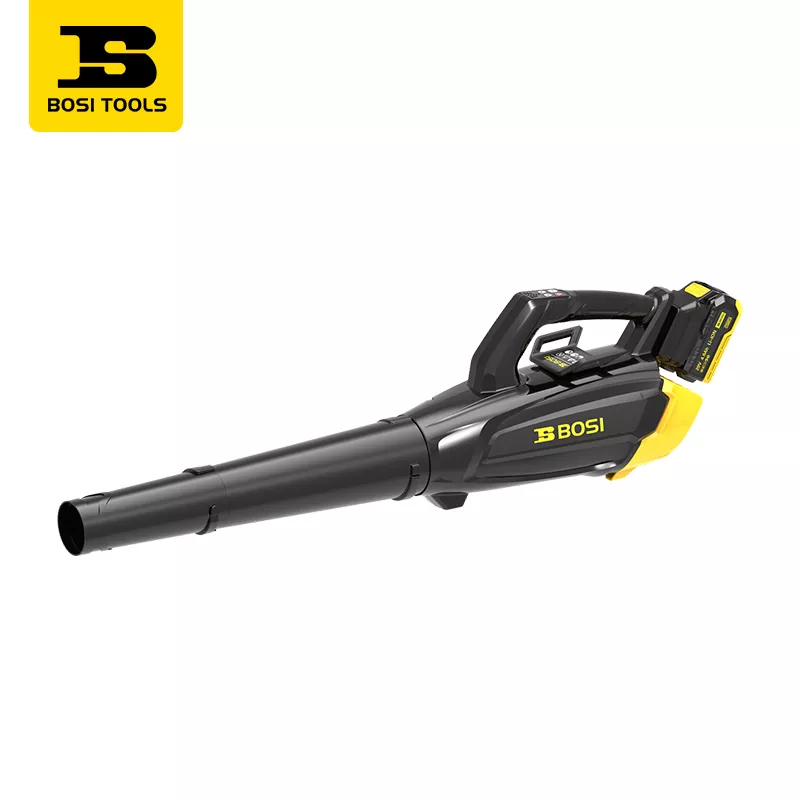
Our BOSI Tools Black Warrior Cool Series Li-ion Brushless Air Blower uses a 20V lithium-ion battery and a brushless motor. It delivers a maximum airflow of 13.2 m³/min and a maximum wind speed of 59 m/s, making it suitable for many high-intensity cleaning applications.
| Comparison Items | BOSI Li-ion Brushless Air Blower | Traditional Gasoline Blower |
|---|---|---|
| Power Source | 20V, 4.0Ah rechargeable lithium battery | Gasoline engine |
| Motor Type | Brushless motor | Internal combustion engine |
| Maximum Airflow | 13.2 m³/min | Varies by engine size and model |
| Maximum Wind Speed | 59 m/s | Varies by model and nozzle design |
| Speed Adjustment | Three settings: 12,000 / 15,000 / 19,000 r/min | Depends on engine and throttle design |
| Starting Method | One-button electric starting | Usually pull-cord starting |
| Exhaust Emissions | No exhaust emissions during operation | Produces engine exhaust |
| Routine Maintenance | Air inlet and battery contact inspection | Engine, spark plug, air filter, and fuel system maintenance |
| Operating Duration | Limited by battery capacity and workload | Can continue after refueling |
| Mobility | Cordless and easy to move between work areas | Portable but requires fuel transportation |
The comparison shows that battery-powered and gasoline equipment have different strengths. The BOSI model offers a combination of strong airflow, cordless operation, and reduced routine maintenance. Gasoline equipment remains useful when uninterrupted operation and extended working time are the main priorities.
For a broader overview of these differences, see Consumer Reports' leaf blower buying guide, which discusses battery capacity, runtime, noise, and gasoline-powered alternatives.
How Does Brushless Motor Technology Improve Performance?
The motor is one of the most important components in a cordless air blower. It determines how efficiently electrical energy is converted into mechanical power and how consistently the equipment performs under different loads.
Traditional brushed motors use carbon brushes to transfer electrical current. These components gradually wear during operation and may require replacement. A brushless motor uses electronic commutation instead, eliminating carbon brush friction and reducing one common source of mechanical wear.
In our Black Warrior Cool Series, the brushless motor works together with turbocharging technology and an optimized air delivery duct. This combination helps accelerate airflow and maintain strong blowing performance.
Three speed settings allow operators to adjust output according to the cleaning task:
- 12,000 r/min – Low speed: Suitable for removing light dust from workbenches, equipment surfaces, and other areas where excessive airflow is unnecessary.
- 15,000 r/min – Medium speed: Appropriate for routine workshop floor cleaning, removing loose debris, and general maintenance.
- 19,000 r/min – High speed: Provides maximum airflow for clearing wet leaves, loose gravel, and light snow from suitable hard surfaces.
This adjustable output is useful because maximum power is not always necessary. Using a lower speed for lighter work can help manage battery consumption and reduce unnecessary airflow around sensitive equipment.
How Long Can a 20V Lithium Battery Air Blower Operate?
Battery runtime is one of the first questions we encounter when discussing cordless equipment. Unlike gasoline models, a lithium battery blower has a defined operating period before the battery needs to be recharged or replaced.
The BOSI Li-ion Brushless Air Blower comes with a 20V, 4.0Ah battery. Based on the supplied product specifications, its approximate operating time is:
| Operating Setting | Speed | Approximate Runtime | Recommended Tasks |
|---|---|---|---|
| Low | 12,000 r/min | 30–40 minutes | Light dust removal and surface cleaning |
| Medium | 15,000 r/min | 30–40 minutes | Workshop and general floor cleaning |
| High | 19,000 r/min | Approximately 15–20 minutes | Wet leaves, loose debris, and light snow |
These figures are approximate and depend on operating conditions, battery temperature, and the actual workload. Continuous high-speed operation consumes more energy, so users should not expect the same runtime at every setting.
For longer working sessions, we recommend preparing a spare compatible battery and arranging charging intervals. This approach is particularly practical for maintenance teams that move between several cleaning areas throughout the day.
Which Applications Are Suitable for a Cordless Air Blower?
A high-performance cordless air blower is not limited to garden maintenance. Its combination of portability and adjustable airflow makes it useful in different working environments.
1. Construction Site Cleaning
Construction sites often accumulate loose dust, dry debris, and small particles on walkways and working surfaces. A high-speed air blower can help move this material into designated collection areas. Its cordless design also makes it convenient to work around temporary structures where power outlets may be limited.
2. Yard and Garden Maintenance
Leaves, grass clippings, and loose organic debris can accumulate around pathways, driveways, and outdoor spaces. The 59 m/s maximum wind speed provides strong airflow for moving loose leaves and similar debris without the need for fuel preparation.
3. Factory Floor and Workshop Cleaning
Manufacturing facilities need regular removal of dust and loose particles from suitable floors and work areas. The medium-speed setting offers more controlled airflow for routine cleaning. Operators should avoid blowing dust toward machinery openings, electrical components, or other sensitive equipment.
4. Parking Lot and Outdoor Surface Cleaning
Parking areas collect dust, leaves, and small debris throughout the day. A cordless blower can be moved between different sections without managing extension cables. For larger areas, spare batteries can help reduce downtime.
5. Light Snow Removal
During winter, loose snow can accumulate on vehicle surfaces, outdoor walkways, and other suitable areas. The high-speed setting can help remove approximately 5–10 cm of loose snow under favorable conditions. However, compacted snow, wet heavy snow, and ice generally require mechanical removal or other suitable equipment.
When Is a Gasoline Blower Still the Better Choice?
We do not believe that every gasoline blower should be replaced by a battery-powered model. Equipment selection should match the actual workload rather than follow a single technology trend.
Gasoline blowers can still be a practical choice in the following situations:
- Extended continuous operation: Large landscaping projects may require several hours of uninterrupted work. Refueling is often faster than waiting for batteries to recharge.
- Very large outdoor areas: Large parks, municipal maintenance projects, and extensive landscaping sites may benefit from backpack or wheeled gasoline equipment.
- Heavy or wet debris: Thick layers of wet leaves and dense debris may require equipment with greater sustained blowing force.
- Limited charging facilities: Remote working locations without convenient charging access may be better served by gasoline-powered equipment.
Battery-powered blowers also have practical limitations. Their performance depends on battery condition, temperature, capacity, and workload. For professional teams, the cost and availability of spare batteries should be considered alongside the equipment itself.
Our recommendation is straightforward: choose a cordless model for frequent, mobile cleaning tasks where convenient starting, reduced maintenance, and no exhaust emissions at the point of use are important. Retain gasoline equipment for applications where extended operation or specialized high-output performance is essential.
How Does BOSI Tools Meet Different Cleaning Requirements?
At BOSI Tools, we have been involved in the industrial tools industry since 2003. With more than 20 years of manufacturing experience, an 80,000 m² factory area, and a product range covering over 10,000 SKUs, we develop tools for different professional and everyday applications.
Our Black Warrior Cool Series Li-ion Brushless Air Blower reflects our focus on combining motor performance, airflow engineering, and practical operation. Rather than relying on a single high-speed specification, we consider how different operating settings serve different cleaning requirements.
Its main specifications include:
- 20V lithium-ion battery with 4.0Ah capacity
- High-efficiency brushless motor
- Three adjustable speed settings
- Maximum airflow of 13.2 m³/min
- Maximum wind speed of 59 m/s
- Turbocharging technology and optimized air delivery duct
- Lightweight body design of approximately 1.8–2.0 kg, including battery
- Ergonomic rubber-coated rear handle and front auxiliary handle
We also focus on handling comfort. The rubber-coated rear handle and front auxiliary handle provide a more stable grip, while the balanced body design helps reduce fatigue during repeated cleaning operations.
For distributors, tool retailers, and professional equipment businesses, selecting a product is about more than its maximum performance figures. Reliability, practical application, product range, and manufacturing capacity all matter when building a long-term product offering. BOSI Tools combines its manufacturing experience and broad tool portfolio to serve different market requirements.
Frequently Asked Questions
1. Can a Li-ion brushless air blower completely replace a gasoline blower?
Not in every application. A battery-powered model can handle many routine cleaning tasks, including workshop dust removal, yard maintenance, parking lot cleaning, and light snow removal. However, gasoline blowers remain suitable for extended continuous operation and demanding large-area applications.
2. Is a 20V air blower powerful enough for professional cleaning?
It depends on the task. The BOSI 20V model delivers up to 13.2 m³/min airflow and 59 m/s wind speed. These specifications make it suitable for many demanding handheld cleaning tasks, although large-scale landscaping may require higher-capacity equipment.
3. What is the advantage of a brushless motor in an air blower?
A brushless motor eliminates carbon brush wear, reducing routine maintenance requirements associated with brushed motors. It also supports efficient power conversion and high-speed operation, making it a practical choice for cordless tools.
4. Can a lithium battery blower remove wet leaves?
Yes, the BOSI model's high-speed setting reaches 19,000 r/min and a maximum wind speed of 59 m/s. It can move some wet leaves, but performance depends on moisture content, leaf density, surface conditions, and the distance between the nozzle and debris. Heavy, compacted leaf layers may require additional cleaning methods.
5. How can I extend the operating time of a cordless air blower?
Use the lowest speed that can complete the task, avoid unnecessary continuous high-speed operation, and keep a spare compatible battery available. Maintaining proper battery storage and charging conditions also helps preserve battery performance.
6. Does a brushless air blower require regular maintenance?
It requires less routine maintenance than a gasoline blower because there is no combustion engine, spark plug, or fuel system. We recommend checking the air inlet, removing accumulated debris, inspecting battery contacts, and storing the equipment in a dry environment.
7. Is a cordless air blower suitable for winter cleaning?
Yes. It can remove loose snow from suitable surfaces, particularly when the snow layer is light and dry. It is not designed to replace snow shovels or mechanical snow removal equipment when dealing with compacted snow or ice.
Conclusion
So, can a Li-ion Air Blower replace traditional gasoline blowers? For many routine and medium-duty cleaning applications, the answer is yes. Modern brushless motors, improved battery technology, and optimized airflow systems have made cordless blowers increasingly capable alternatives.
However, the best choice still depends on operating time, cleaning intensity, work area, and battery availability. Our BOSI Tools Li-ion Brushless Air Blower combines a 20V battery platform, three-speed adjustment, 13.2 m³/min maximum airflow, and 59 m/s maximum wind speed to provide a practical solution for mobile cleaning tasks.
We believe the future of cleaning equipment is not about choosing battery power over gasoline in every situation. It is about matching the right power system and performance level to the job.
Related News
- Cordless Impact Wrench Buying Guide: Torque, Drive Size, and Battery Selection
- Angle Grinder Buying Guide: How to Choose Size, Power, Speed, and Discs
- Brushless vs. Brushed Drills: Differences, Performance, and Cost
- Drill Bit Types and Uses: How to Choose for Wood, Metal, and Concrete
- Hammer Drill vs. Rotary Hammer: Which Do You Need for Concrete?
- Cordless Drill Buying Guide: How to Choose the Right Drill and Kit

-
E-mail